Year 10 (ages 14–15, Grade 9 in the US) · Science · Physics: radioactivity · Lesson 1
Atomic models and nuclear notation
How models of the atom developed from Dalton to Bohr and Chadwick, the structure of the nucleus, nuclear notation with mass and atomic numbers, isotopes, and how atoms form ions.
Exam boards: this lesson matches the AQA and Pearson Edexcel GCSE science courses. Check which course your school follows.
9-minute video lesson
Teaching, worked examples and 20 practice questions solved step by step.
Watch free for a monthWhat your child will learn
- Describe how atomic models changed
- Explain the alpha scattering evidence
- Use nuclear notation
- Explain isotopes and ions
The method
- Mass number (top) = protons + neutrons.
- Atomic number (bottom) = protons.
- Isotopes: same protons, different neutrons.
- Ions: atoms that have lost or gained electrons.
Key words: nucleus, alpha scattering, isotope, ion, nuclear notation.
Worked examples
Worked examples from the lesson, with every step.
Question 1
Uranium-238 has atomic number 92. How many neutrons?
- Step 1: neutrons = mass − atomic
- Step 2: 238 − 92 = 146
Answer: 146
Question 2
Why did most alpha particles pass straight through the gold foil?
- Step 1: No deflection.
- Step 2: The atom is mostly empty space.
Answer: atoms are mostly empty space
Question 3
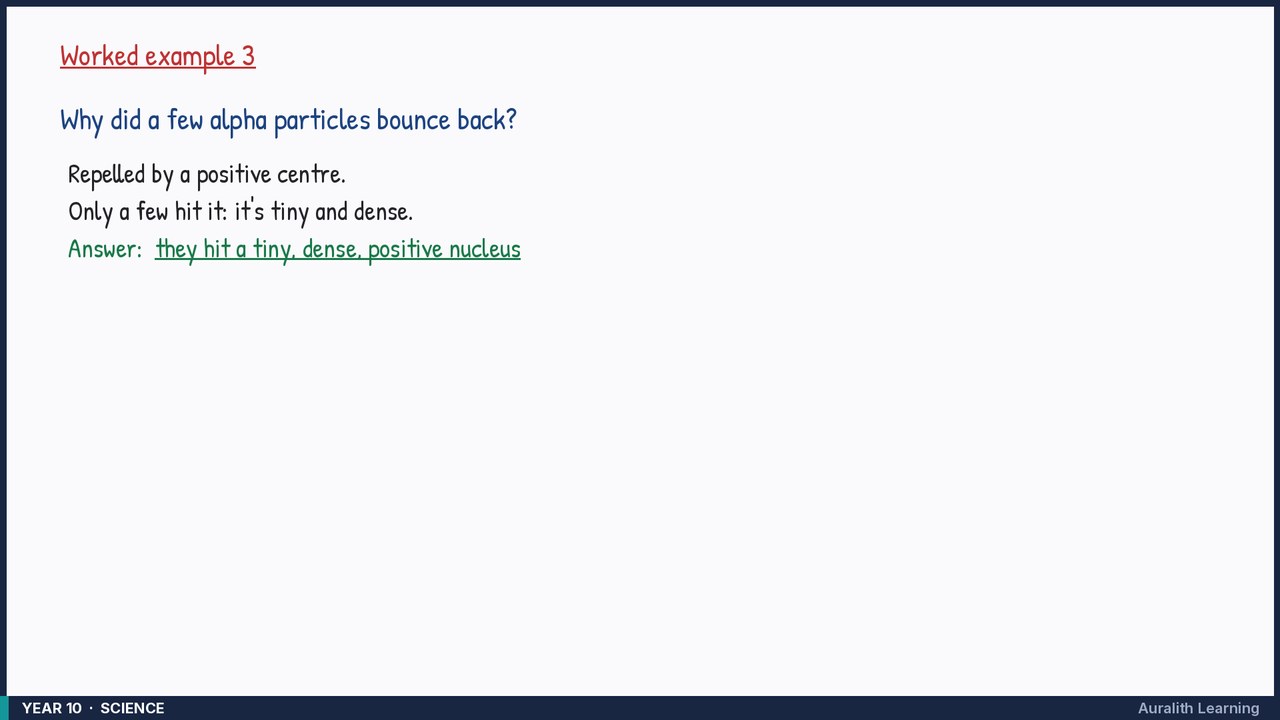
Why did a few alpha particles bounce back?
- Step 1: Repelled by a positive centre.
- Step 2: Only a few hit it: it's tiny and dense.
Answer: they hit a tiny, dense, positive nucleus