Year 10 (ages 14–15, Grade 9 in the US) · Science · Chemistry: states of matter and mixtures · Lesson 1
States of matter and changes of state
The particle model of solids, liquids and gases, changes of state and the energy involved, predicting states from melting and boiling points, and the difference between physical and chemical changes.
Exam boards: this lesson matches the AQA and Pearson Edexcel GCSE science courses. Check which course your school follows.
9-minute video lesson
Teaching, worked examples and 20 practice questions solved step by step.
Watch free for a monthWhat your child will learn
- Describe particles in solids, liquids and gases
- Explain changes of state using energy
- Predict state from melting and boiling points
- Distinguish physical and chemical changes
The method
- Solid: fixed positions, vibrating.
- Liquid: close together, moving past each other.
- Gas: far apart, moving fast and randomly.
- Compare the temperature with the melting and boiling points.
Key words: particle model, melting point, boiling point, sublimation, physical change.
Worked examples
Worked examples from the lesson, with every step.
Question 1
Describe the arrangement and movement of particles in a liquid.
- Step 1: Close together, irregular.
- Step 2: Move past each other.
Answer: close together, moving past each other
Question 2
Ethanol melts at −114 °C and boils at 78 °C. What is its state at 25 °C?
- Step 1: 25 is above −114 and below 78.
- Step 2: Between them → liquid.
Answer: liquid
Question 3
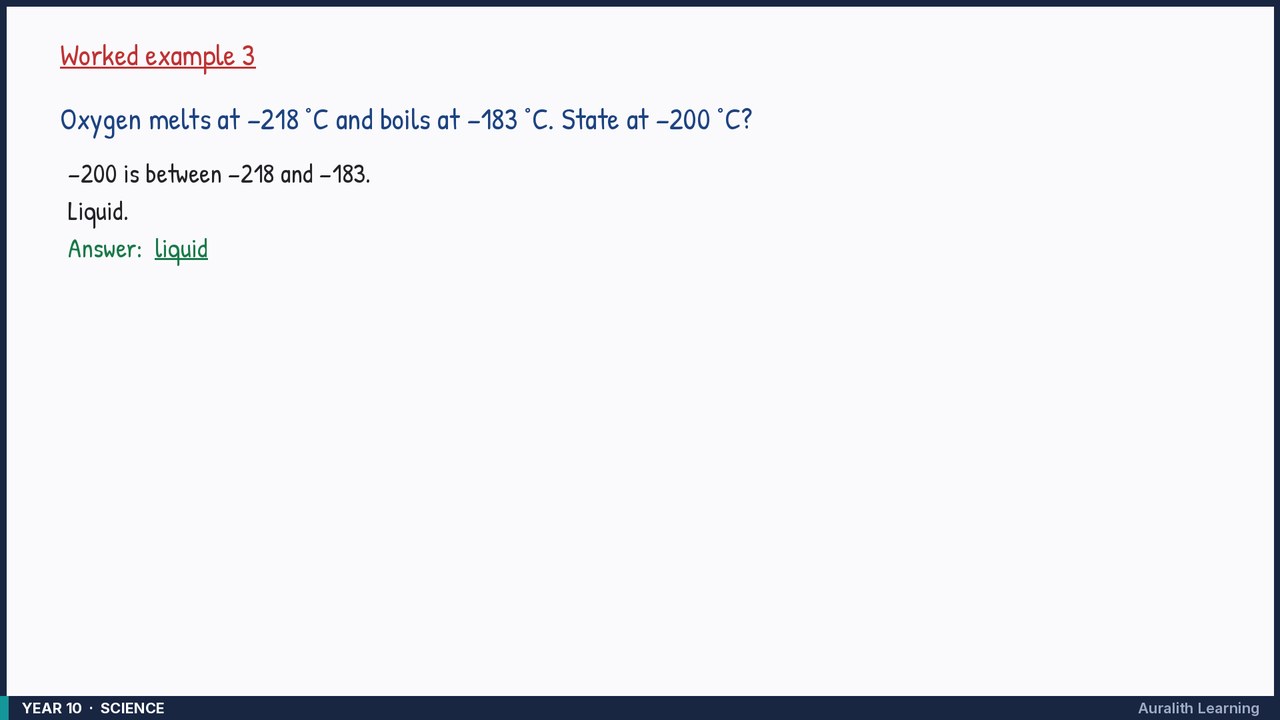
Oxygen melts at −218 °C and boils at −183 °C. State at −200 °C?
- Step 1: −200 is between −218 and −183.
- Step 2: Liquid.
Answer: liquid