Year 10 (ages 14–15, Grade 9 in the US) · Science · Chemistry: states of matter and mixtures · Lesson 3
Paper chromatography and Rf values
How paper chromatography separates soluble substances, setting up the experiment correctly, interpreting chromatograms, and calculating Rf values to identify substances.
Exam boards: this lesson matches the AQA and Pearson Edexcel GCSE science courses. Check which course your school follows.
9-minute video lesson
Teaching, worked examples and 20 practice questions solved step by step.
Watch free for a monthWhat your child will learn
- Describe how chromatography separates substances
- Set up a fair chromatography experiment
- Interpret a chromatogram
- Calculate and use Rf values
The method
- Draw the start line in pencil.
- Keep spots above the solvent level.
- Rf = distance moved by spot ÷ distance moved by solvent.
- Match Rf values to identify substances.
Key words: chromatography, stationary phase, mobile phase, Rf value, solvent front.
Worked examples
Worked examples from the lesson, with every step.
Question 1
A spot moves 3.0 cm; the solvent moves 6.0 cm. Calculate Rf.
- Step 1: Rf = spot ÷ solvent
- Step 2: 3.0 ÷ 6.0 = 0.5
Answer: 0.5
Question 2
A spot moves 4.2 cm; the solvent front is 7.0 cm. Calculate Rf.
- Step 1: 4.2 ÷ 7.0
- Step 2: = 0.6
Answer: 0.6
Question 3
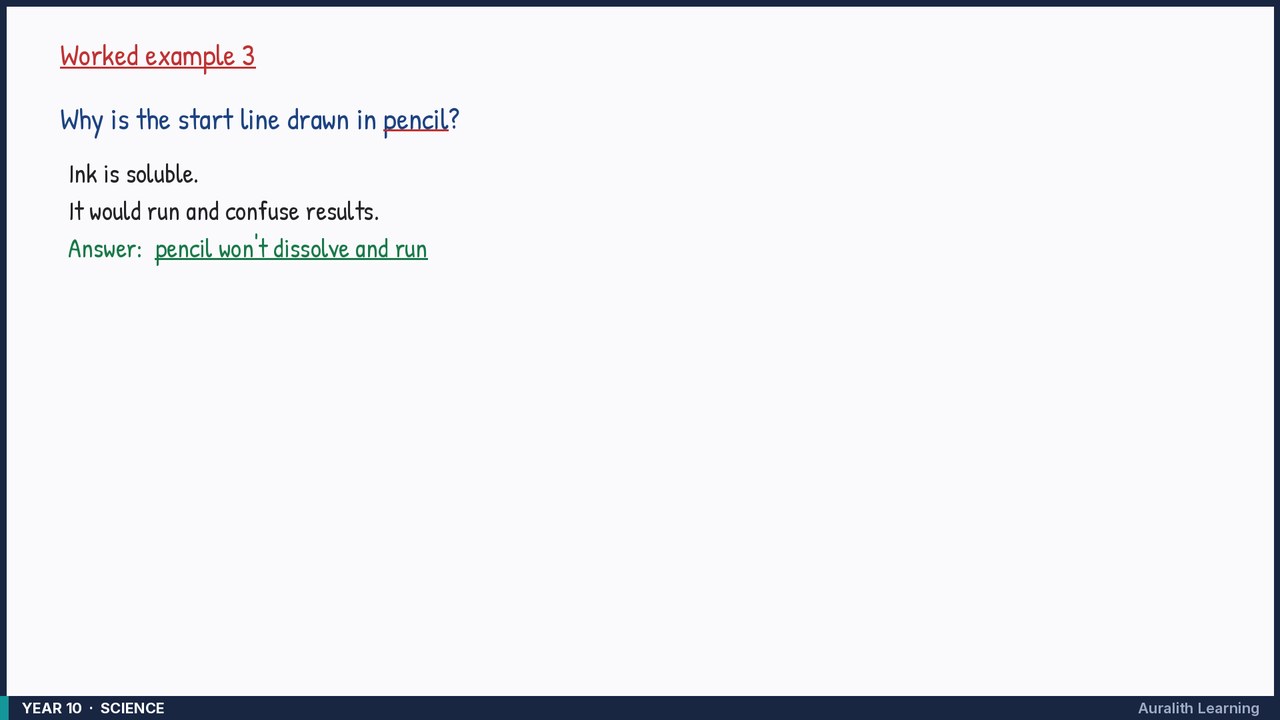
Why is the start line drawn in pencil?
- Step 1: Ink is soluble.
- Step 2: It would run and confuse results.
Answer: pencil won't dissolve and run