Year 10 (ages 14–15, Grade 9 in the US) · Science · Physics: motion and forces · Lesson 1
Speed, velocity and distance–time graphs
Scalars and vectors, calculating speed with distance = speed × time, typical speeds, and reading speed from the gradient of a distance–time graph.
Exam boards: this lesson matches the AQA and Pearson Edexcel GCSE science courses. Check which course your school follows.
9-minute video lesson
Teaching, worked examples and 20 practice questions solved step by step.
Watch free for a monthWhat your child will learn
- Distinguish scalars and vectors
- Use distance = average speed × time
- Recall typical everyday speeds
- Find speed from a distance–time graph
The method
- Write the equation: speed = distance ÷ time.
- Check units: m and s give m/s.
- On a distance–time graph, gradient = speed.
- Flat line = stationary; steeper = faster.
Key words: scalar, vector, speed, velocity, gradient.
Worked examples
Worked examples from the lesson, with every step.
Question 1
A cyclist travels 1200 m in 200 s. Calculate the average speed.
- Step 1: speed = distance ÷ time
- Step 2: 1200 ÷ 200 = 6
Answer: 6 m/s
Question 2
A car moves at 25 m/s for 40 s. How far does it travel?
- Step 1: distance = speed × time
- Step 2: 25 × 40 = 1000
Answer: 1000 m
Question 3
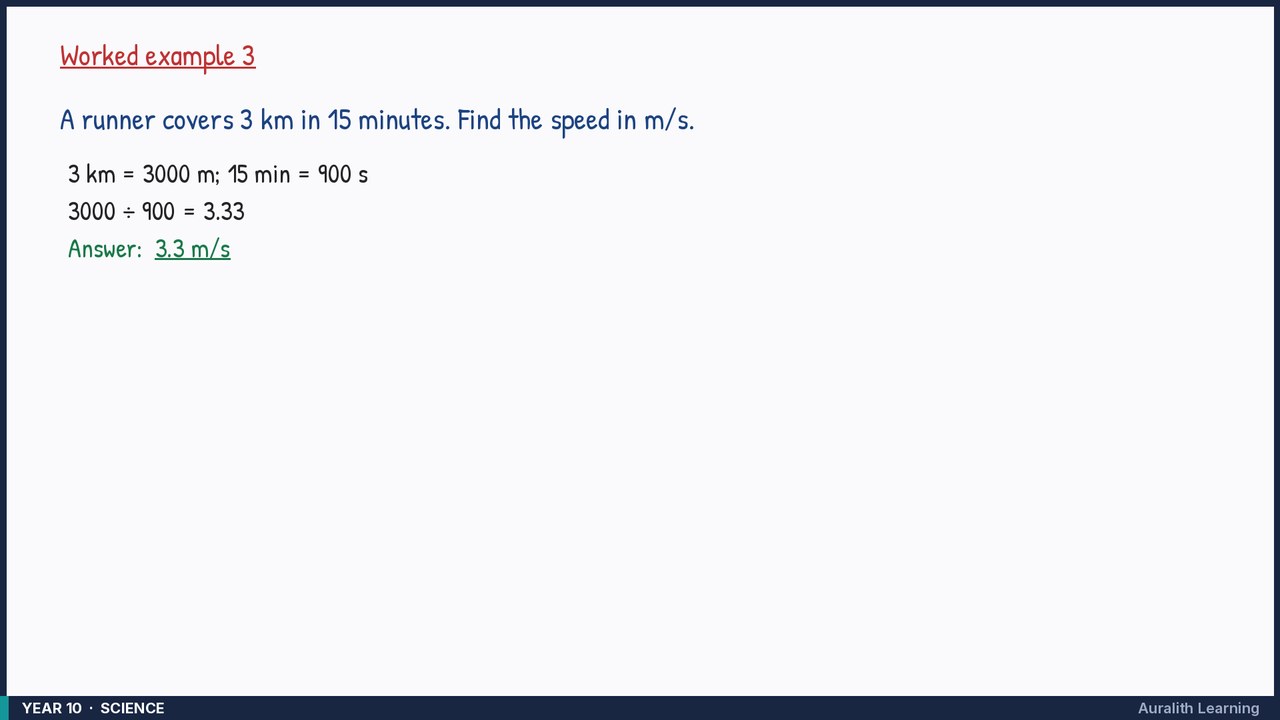
A runner covers 3 km in 15 minutes. Find the speed in m/s.
- Step 1: 3 km = 3000 m; 15 min = 900 s
- Step 2: 3000 ÷ 900 = 3.33
Answer: 3.3 m/s