Year 10 (ages 14–15, Grade 9 in the US) · Science · Physics: motion and forces · Lesson 3
Newton's laws, mass and weight
Resultant forces, Newton's first, second and third laws, using F = m × a, the difference between mass and weight with W = m × g, and inertia.
Exam boards: this lesson matches the AQA and Pearson Edexcel GCSE science courses. Check which course your school follows.
9-minute video lesson
Teaching, worked examples and 20 practice questions solved step by step.
Watch free for a monthWhat your child will learn
- Calculate a resultant force
- Apply Newton's first and third laws
- Use F = m × a
- Calculate weight using W = m × g
The method
- Find the resultant force: add same-direction forces, subtract opposite ones.
- Zero resultant: no change in motion (first law).
- F = m × a: bigger force, bigger acceleration (second law).
- W = m × g; on Earth g = 10 N/kg.
Key words: resultant force, Newton's laws, inertia, weight, gravitational field strength.
Worked examples
Worked examples from the lesson, with every step.
Question 1
Forces of 100 N forwards and 40 N backwards act on a box. Find the resultant.
- Step 1: Opposite: subtract.
- Step 2: 100 − 40 = 60
Answer: 60 N forwards
Question 2
A 1200 kg car accelerates at 2 m/s². Find the resultant force.
- Step 1: F = m × a
- Step 2: 1200 × 2 = 2400
Answer: 2400 N
Question 3
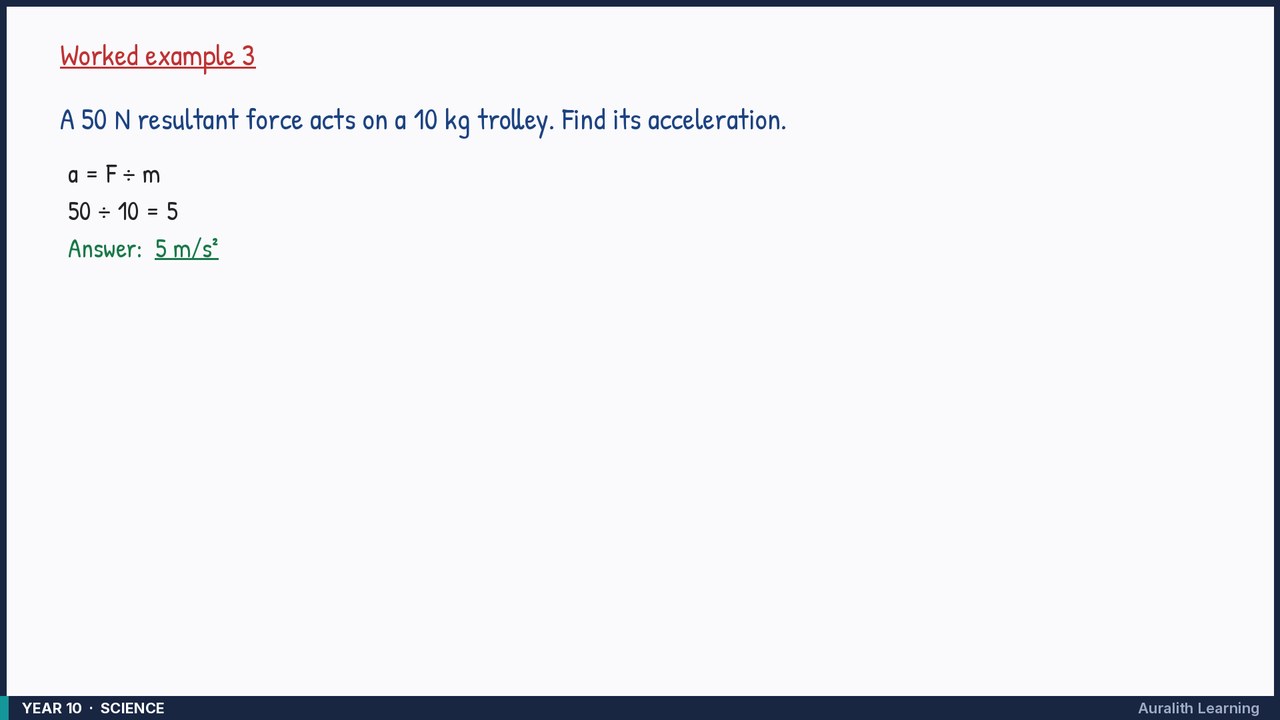
A 50 N resultant force acts on a 10 kg trolley. Find its acceleration.
- Step 1: a = F ÷ m
- Step 2: 50 ÷ 10 = 5
Answer: 5 m/s²