Year 10 (ages 14–15, Grade 9 in the US) · Science · Physics: conservation of energy · Lesson 1
Energy stores, kinetic and gravitational energy
The main energy stores and how energy is transferred between them, the law of conservation of energy, and calculating kinetic energy (½mv²) and gravitational potential energy (mgh).
Exam boards: this lesson matches the AQA and Pearson Edexcel GCSE science courses. Check which course your school follows.
9-minute video lesson
Teaching, worked examples and 20 practice questions solved step by step.
Watch free for a monthWhat your child will learn
- Name energy stores and transfer pathways
- State the conservation of energy
- Calculate kinetic energy
- Calculate change in gravitational potential energy
The method
- Identify the stores before and after.
- KE = ½ × m × v².
- ΔGPE = m × g × Δh (g = 10 N/kg).
- Energy is never created or destroyed: totals stay the same.
Key words: energy store, conservation of energy, kinetic energy, gravitational potential energy, joule.
Worked examples
Worked examples from the lesson, with every step.
Question 1
Calculate the KE of a 2 kg ball moving at 3 m/s.
- Step 1: 3² = 9
- Step 2: ½ × 2 × 9
- Step 3: = 9
Answer: 9 J
Question 2
Calculate the KE of a 1000 kg car at 20 m/s.
- Step 1: 20² = 400
- Step 2: ½ × 1000 × 400
- Step 3: = 200 000
Answer: 200 000 J
Question 3
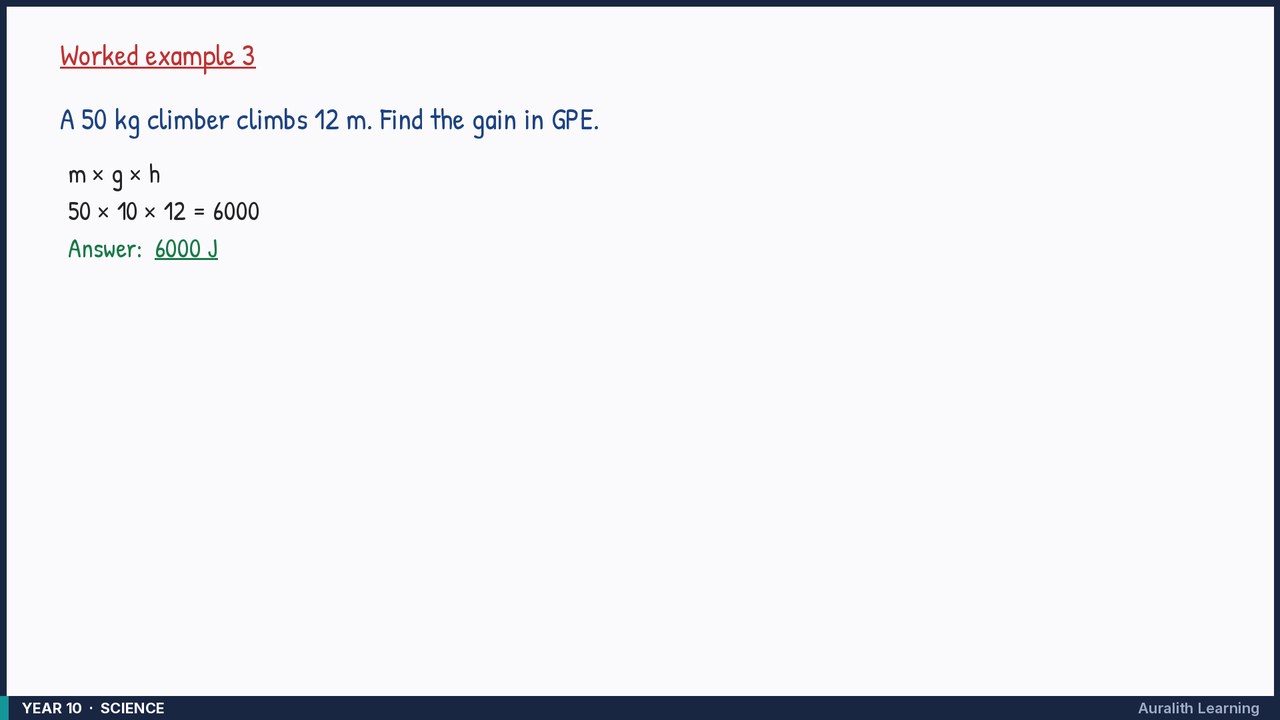
A 50 kg climber climbs 12 m. Find the gain in GPE.
- Step 1: m × g × h
- Step 2: 50 × 10 × 12 = 6000
Answer: 6000 J