Year 10 (ages 14–15, Grade 9 in the US) · Science · Physics: conservation of energy · Lesson 2
Efficiency, power and reducing waste
Calculating efficiency as a decimal or percentage, power as energy transferred per second, and reducing unwanted energy transfers with lubrication and thermal insulation, including thermal conductivity.
Exam boards: this lesson matches the AQA and Pearson Edexcel GCSE science courses. Check which course your school follows.
9-minute video lesson
Teaching, worked examples and 20 practice questions solved step by step.
Watch free for a monthWhat your child will learn
- Calculate efficiency
- Calculate power
- Explain how lubrication reduces waste
- Explain how insulation reduces heat loss
The method
- efficiency = useful energy out ÷ total energy in (× 100 for %).
- power (W) = energy (J) ÷ time (s).
- Lubrication reduces friction.
- Insulation: low thermal conductivity, thick layers.
Key words: efficiency, useful energy, power, watt, thermal conductivity.
Worked examples
Worked examples from the lesson, with every step.
Question 1
A lamp uses 100 J and gives out 20 J of light. Find the efficiency.
- Step 1: useful ÷ total
- Step 2: 20 ÷ 100 = 0.2
- Step 3: × 100 = 20%
Answer: 0.2 (20%)
Question 2
A motor is 75% efficient. It is supplied with 400 J. How much useful energy is transferred?
- Step 1: useful = efficiency × total
- Step 2: 0.75 × 400 = 300
Answer: 300 J
Question 3
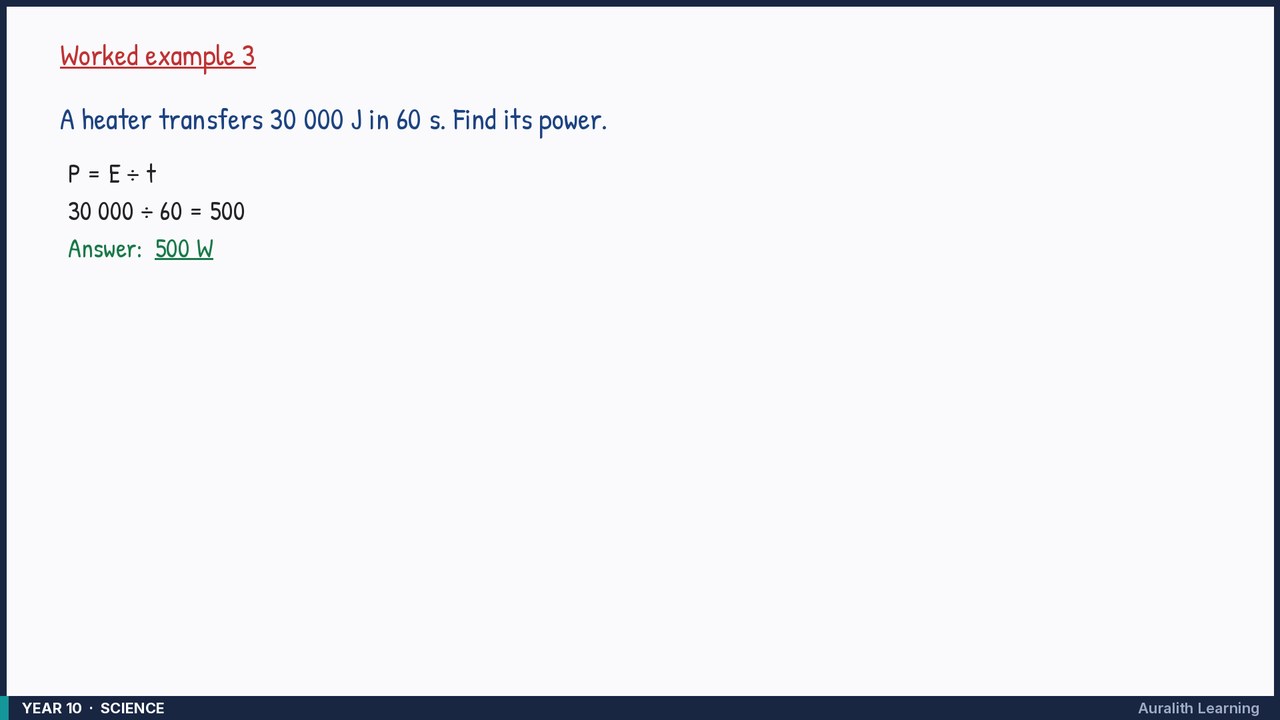
A heater transfers 30 000 J in 60 s. Find its power.
- Step 1: P = E ÷ t
- Step 2: 30 000 ÷ 60 = 500
Answer: 500 W