Year 10 (ages 14–15, Grade 9 in the US) · RSHE and PSHE · Healthy relationships and consent · Lesson 1
Understanding consent
What consent means: freely given, by someone with the capacity to choose, and able to be withdrawn at any time. How consent applies in everyday life and relationships, what the law says, and how to ask, give and respect an answer.
8-minute video lesson
Teaching, worked examples and 20 practice questions solved step by step.
Watch free for a monthWhat your child will learn
- Define consent
- Explain freedom and capacity to consent
- Explain that consent can be withdrawn
- Describe what the law says
The method
- Consent is a clear, free ‘yes’ — not silence or pressure.
- The person must have the capacity to choose.
- Consent can be withdrawn at any time.
- If unsure, ask — and respect the answer.
Key words: consent, capacity, pressure, withdraw, respect.
Worked examples
Worked examples from the lesson, with every step.
Question 1
Is silence a sign of consent?
- Step 1: Consent must be a clear, free yes.
- Step 2: Silence is not consent.
Answer: no
Question 2
Sam agreed earlier but now says ‘stop’. What should happen?
- Step 1: Consent can be withdrawn at any time.
- Step 2: Stop immediately and respect it.
Answer: stop straight away — consent has been withdrawn
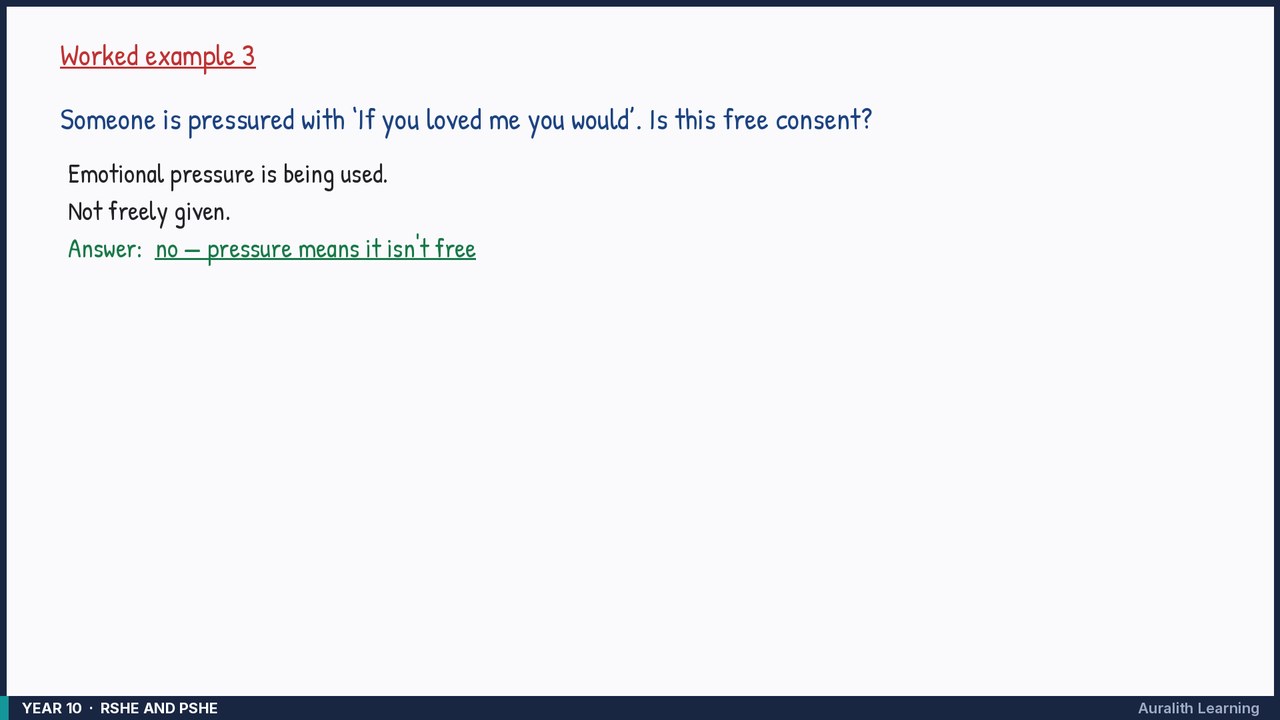
Question 3
Someone is pressured with ‘If you loved me you would’. Is this free consent?
- Step 1: Emotional pressure is being used.
- Step 2: Not freely given.
Answer: no — pressure means it isn't free