Year 10 (ages 14–15, Grade 9 in the US) · RSHE and PSHE · Healthy relationships and consent · Lesson 2
Healthy and unhealthy relationships
What makes a relationship healthy, the warning signs of an unhealthy or controlling relationship, what coercive control is and that it is a crime, and how to support a friend and get help.
8-minute video lesson
Teaching, worked examples and 20 practice questions solved step by step.
Watch free for a monthWhat your child will learn
- Describe features of a healthy relationship
- Recognise warning signs of control
- Explain coercive control
- Know how to get help
The method
- Healthy: respect, trust, honesty, equality.
- Unhealthy: control, jealousy, isolation, fear.
- Patterns matter more than one moment.
- Get help: trusted adult, Childline, police in an emergency.
Key words: respect, trust, coercive control, warning sign, support.
Worked examples
Worked examples from the lesson, with every step.
Question 1
Give two features of a healthy relationship.
- Step 1: Respect.
- Step 2: Trust.
Answer: respect and trust
Question 2
Jo's partner checks Jo's phone every day and gets angry about messages. Is this healthy?
- Step 1: Checking and anger.
- Step 2: A warning sign.
Answer: no — it is controlling
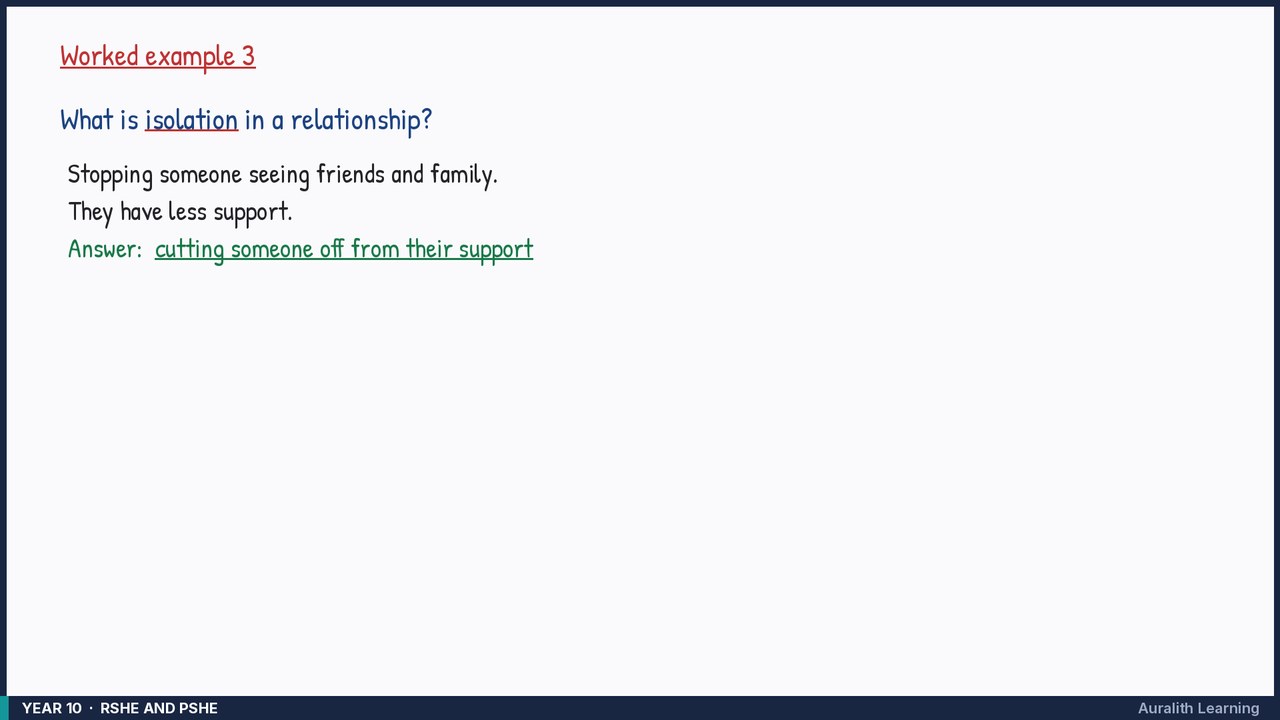
Question 3
What is isolation in a relationship?
- Step 1: Stopping someone seeing friends and family.
- Step 2: They have less support.
Answer: cutting someone off from their support