Year 10 (ages 14–15, Grade 9 in the US) · RSHE and PSHE · Careers and money · Lesson 4
Saving, borrowing and staying safe with money
Why and how to save, simple and compound interest, the cost of borrowing and APR, overdrafts, credit cards and credit scores, and how to spot money scams, including being targeted as a money mule.
9-minute video lesson
Teaching, worked examples and 20 practice questions solved step by step.
Watch free for a monthWhat your child will learn
- Explain the benefits of saving
- Calculate simple and compound interest
- Explain APR and the cost of borrowing
- Spot common scams
The method
- Saving: interest is paid to you.
- Borrowing: you pay interest — compare APR.
- Compound interest: interest on interest.
- Scams: if it sounds too good to be true, it probably is.
Key words: interest, compound interest, APR, credit score, money mule.
Worked examples
Worked examples from the lesson, with every step.
Question 1
£500 at 4% simple interest for 3 years. Find the interest.
- Step 1: 0.04 × 500 = £20
- Step 2: 3 × £20 = £60
Answer: £60
Question 2
£1000 at 10% compound interest for 2 years. Find the total.
- Step 1: 1000 × 1.1 = £1100
- Step 2: 1100 × 1.1 = £1210
Answer: £1210
Question 3
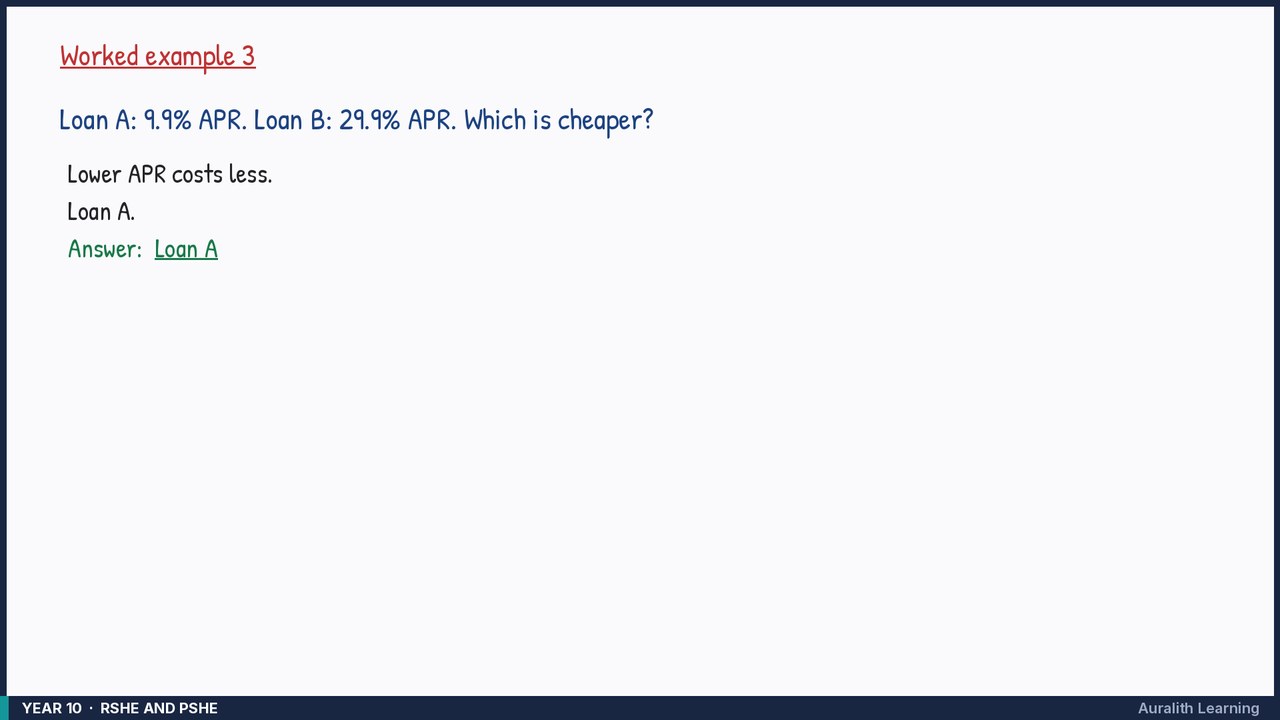
Loan A: 9.9% APR. Loan B: 29.9% APR. Which is cheaper?
- Step 1: Lower APR costs less.
- Step 2: Loan A.
Answer: Loan A