Year 10 (ages 14–15, Grade 9 in the US) · Music · GCSE listening and theory · Lesson 1
The elements of music (DR SMITH)
Using the DR SMITH checklist — dynamics, rhythm, structure, melody, instrumentation, texture and harmony, plus tempo and tonality — to listen closely and describe music accurately in GCSE listening questions.
Exam boards: this lesson matches the AQA and Pearson Edexcel GCSE music courses. Check which course your school follows.
8-minute video lesson
Teaching, worked examples and 20 practice questions solved step by step.
Watch free for a monthWhat your child will learn
- Recall the DR SMITH elements
- Use correct vocabulary for each element
- Describe music using several elements
- Answer listening questions precisely
The method
- Listen once for the big picture.
- Work through DR SMITH, one element at a time.
- Use precise words: ‘crescendo’, not ‘gets louder’ — or both.
- Give evidence: where in the music it happens.
Key words: dynamics, texture, tonality, ostinato, syncopation.
Worked examples
Worked examples from the lesson, with every step.
Question 1
A tune moves mostly by step. Describe it.
- Step 1: Melody.
- Step 2: Conjunct.
Answer: conjunct
Question 2
A piece has an A section, a B section, then A again. What is the structure?
- Step 1: A B A.
- Step 2: Ternary form.
Answer: ternary
Question 3
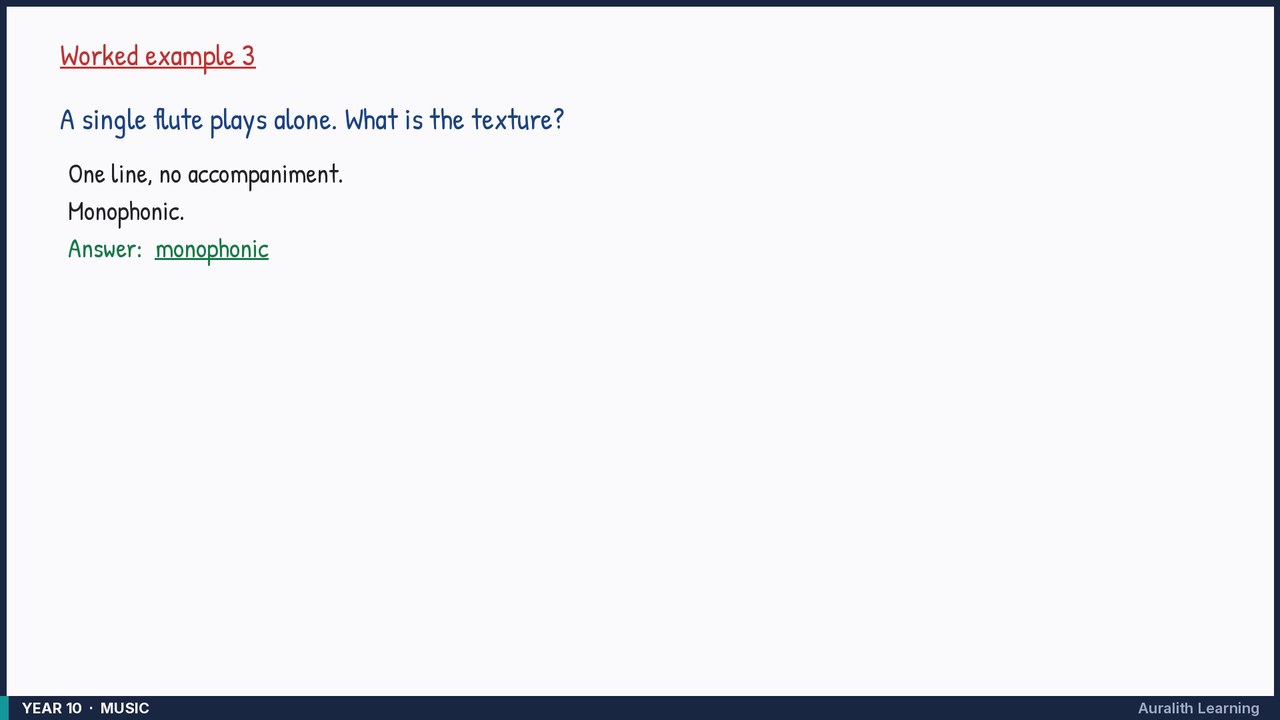
A single flute plays alone. What is the texture?
- Step 1: One line, no accompaniment.
- Step 2: Monophonic.
Answer: monophonic