Year 10 (ages 14–15, Grade 9 in the US) · Music · GCSE listening and theory · Lesson 2
Chords, cadences and keys
Building triads, the primary chords I, IV and V, the four cadences (perfect, plagal, imperfect, interrupted), key signatures for common keys, relative minors and modulation.
Exam boards: this lesson matches the AQA and Pearson Edexcel GCSE music courses. Check which course your school follows.
8-minute video lesson
Teaching, worked examples and 20 practice questions solved step by step.
Watch free for a monthWhat your child will learn
- Build a triad on any note
- Name the primary chords in a key
- Identify the four cadences
- Recognise common key signatures and relative minors
The method
- Triad: root, 3rd and 5th — skip a note each time.
- Primary chords: I, IV and V.
- Cadences: perfect V–I, plagal IV–I, imperfect ends on V, interrupted V–VI.
- Key signature → major key → relative minor (down three semitones).
Key words: triad, primary chords, perfect cadence, relative minor, modulation.
Worked examples
Worked examples from the lesson, with every step.
Question 1
Build a triad on F.
- Step 1: F, (G), A, (B♭), C
- Step 2: F – A – C
Answer: F, A, C
Question 2
Name chords I, IV and V in F major.
- Step 1: F G A B♭ C D E
- Step 2: 1st = F, 4th = B♭, 5th = C
Answer: F, B♭ and C
Question 3
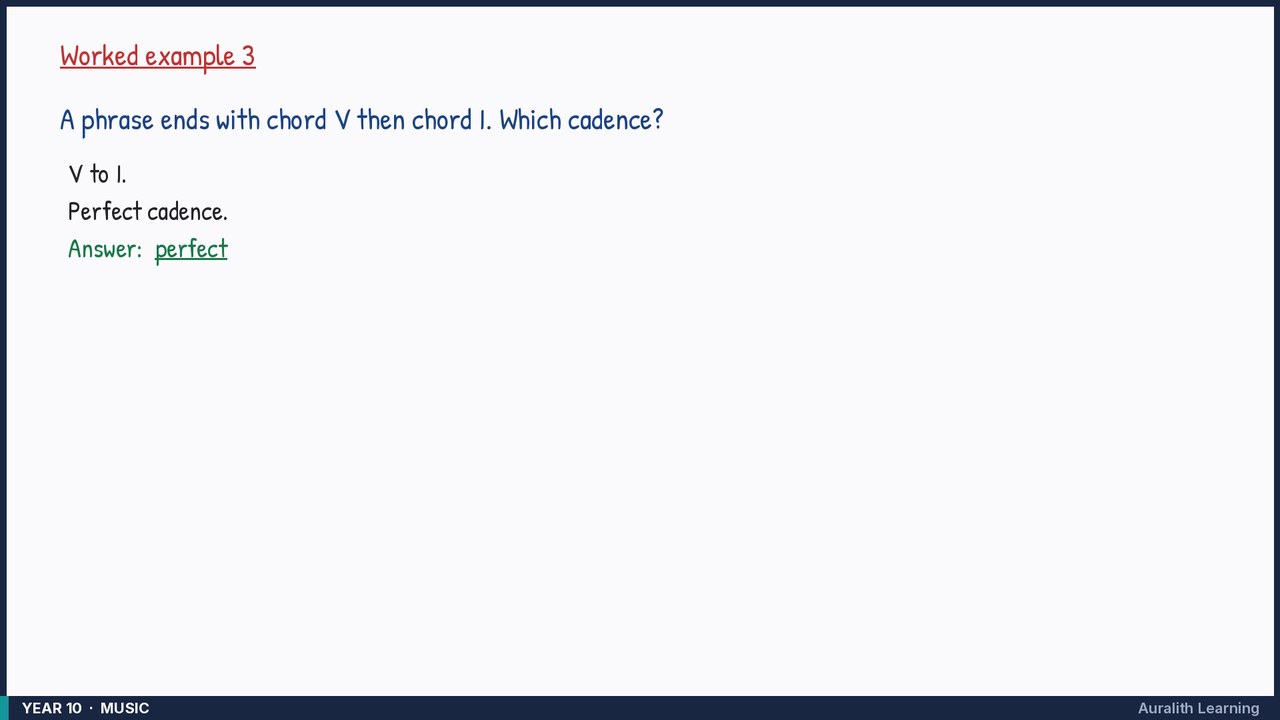
A phrase ends with chord V then chord I. Which cadence?
- Step 1: V to I.
- Step 2: Perfect cadence.
Answer: perfect