Year 10 (ages 14–15, Grade 9 in the US) · English · Imaginative writing · Lesson 3
Sentences and punctuation for effect
Earning AO6 marks: varying sentence length and openings, and using commas, semicolons, colons, dashes and ellipses accurately for effect in imaginative writing.
Exam boards: this lesson matches the AQA and Pearson Edexcel GCSE English courses. Check which course your school follows.
8-minute video lesson
Teaching, worked examples and 20 practice questions solved step by step.
Watch free for a monthWhat your child will learn
- Vary sentence length for effect
- Vary sentence openings
- Use a range of punctuation accurately
- Avoid comma splices
The method
- Use a short sentence for impact after longer ones.
- Start sentences in different ways.
- Use one semicolon, one colon and one dash correctly.
- Check: no comma joining two full sentences.
Key words: AO6, short sentence, semicolon, colon, comma splice.
Worked examples
Worked examples from the lesson, with every step.
Question 1
Add a short sentence for impact after: ‘We waited for hours in the freezing car park, watching every set of headlights sweep past.’
- Step 1: A sudden change or key moment.
- Step 2: Keep it very short.
Answer: ‘Then they came.’
Question 2
Rewrite starting with an -ing verb: ‘I held my breath and opened the letter.’
- Step 1: Put the action first.
- Step 2: Comma after the opening clause.
Answer: ‘Holding my breath, I opened the letter.’
Question 3
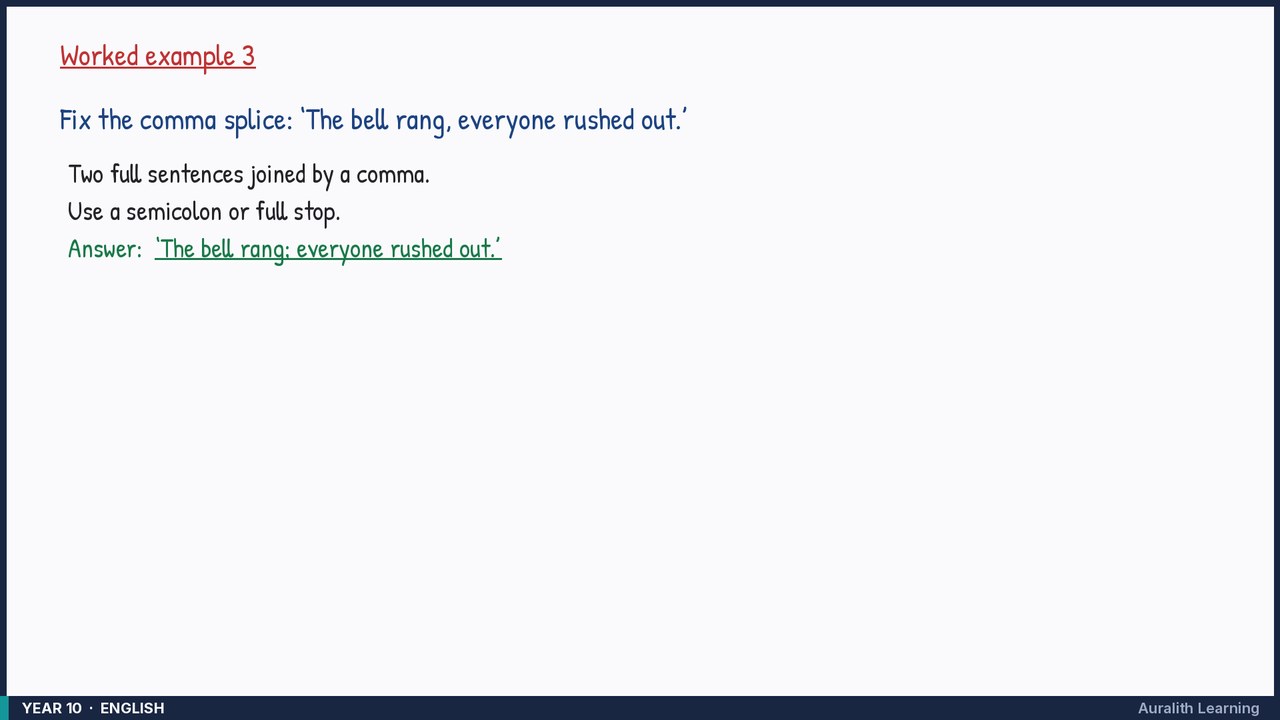
Fix the comma splice: ‘The bell rang, everyone rushed out.’
- Step 1: Two full sentences joined by a comma.
- Step 2: Use a semicolon or full stop.
Answer: ‘The bell rang; everyone rushed out.’