Year 10 (ages 14–15, Grade 9 in the US) · English · Imaginative writing · Lesson 2
Bringing writing to life: show, don't tell
Techniques for vivid imaginative writing: showing feelings through actions, using the five senses, fresh imagery and precise vocabulary, with before-and-after examples.
Exam boards: this lesson matches the AQA and Pearson Edexcel GCSE English courses. Check which course your school follows.
8-minute video lesson
Teaching, worked examples and 20 practice questions solved step by step.
Watch free for a monthWhat your child will learn
- Show feelings instead of naming them
- Use all five senses
- Create fresh similes and metaphors
- Choose precise verbs and nouns
The method
- Replace a feeling word with an action or body reaction.
- Add one detail for each sense.
- Make one fresh comparison; avoid clichés.
- Swap weak verbs for precise ones.
Key words: show not tell, sensory detail, imagery, precise vocabulary, cliché.
Worked examples
Worked examples from the lesson, with every step.
Question 1
Rewrite to show, not tell: ‘I was angry.’
- Step 1: What does anger do to the body?
- Step 2: Clenched jaw, hot face.
Answer: ‘My jaw clenched and heat crawled up my neck.’
Question 2
Add two senses to: ‘I walked into the kitchen.’
- Step 1: Burnt toast.
- Step 2: The kettle rattling.
Answer: ‘The kitchen smelt of burnt toast, and the kettle rattled on its base.’
Question 3
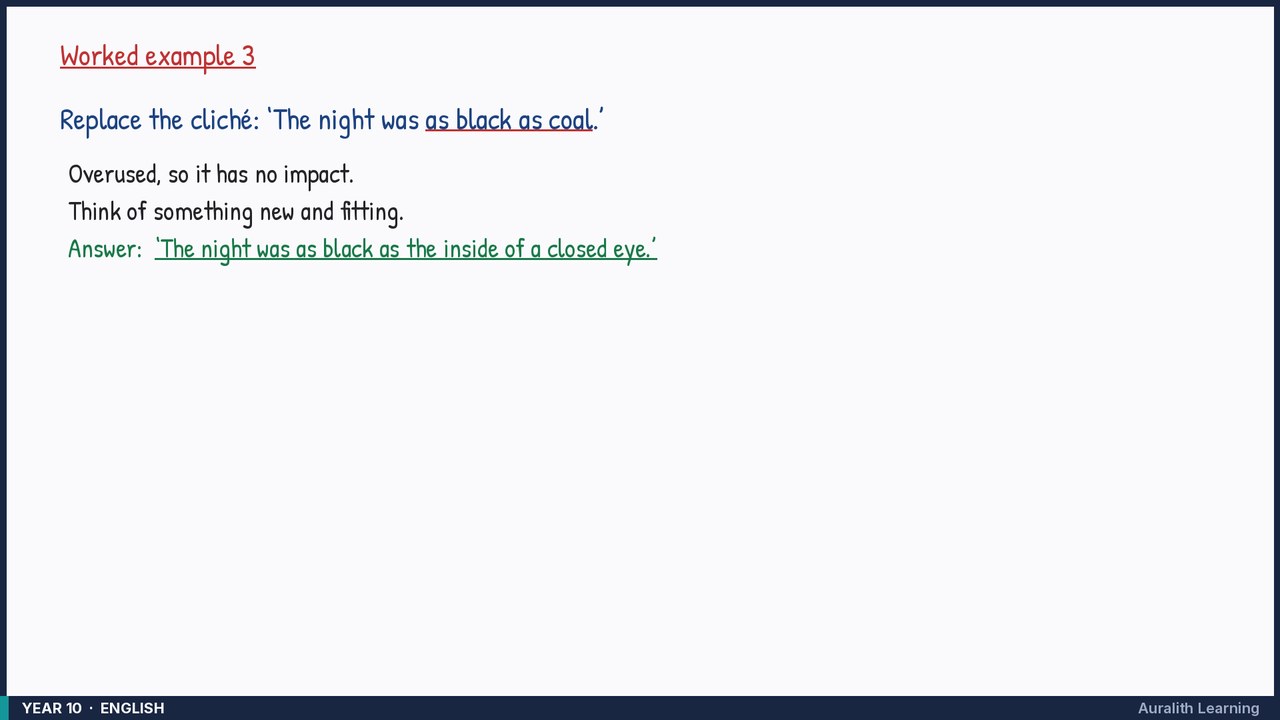
Replace the cliché: ‘The night was as black as coal.’
- Step 1: Overused, so it has no impact.
- Step 2: Think of something new and fitting.
Answer: ‘The night was as black as the inside of a closed eye.’