Year 10 (ages 14–15, Grade 9 in the US) · Design and technology · Core technical principles · Lesson 2
Motion, levers and gears
The four types of motion, the three classes of lever, mechanical advantage, and how gears change speed and direction, with gear ratio and output speed calculations.
Exam boards: this lesson matches the AQA and Pearson Edexcel GCSE design and technology courses. Check which course your school follows.
9-minute video lesson
Teaching, worked examples and 20 practice questions solved step by step.
Watch free for a monthWhat your child will learn
- Name the four types of motion
- Identify the three classes of lever
- Calculate mechanical advantage
- Calculate gear ratios and output speed
The method
- Motion: linear, rotary, reciprocating, oscillating.
- Lever class: what's in the middle — fulcrum, load or effort?
- Mechanical advantage = load ÷ effort.
- Gear ratio = driven teeth ÷ driver teeth; output speed = input speed ÷ ratio.
Key words: fulcrum, mechanical advantage, gear ratio, driver gear, idler gear.
Worked examples
Worked examples from the lesson, with every step.
Question 1
What type of motion does a sewing machine needle have?
- Step 1: Up and down in a straight line, repeatedly.
- Step 2: Reciprocating.
Answer: reciprocating
Question 2
Which class of lever is a wheelbarrow?
- Step 1: The load is between wheel and handles.
- Step 2: Load in the middle → class 2.
Answer: class 2
Question 3
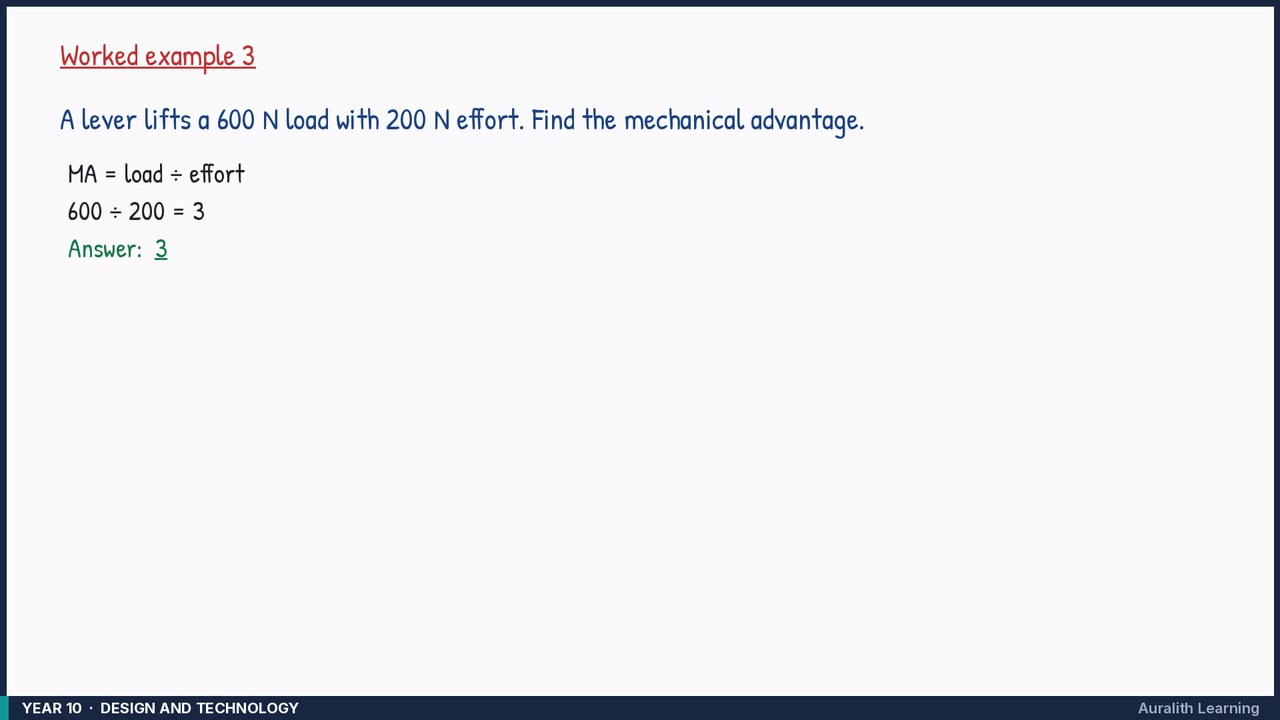
A lever lifts a 600 N load with 200 N effort. Find the mechanical advantage.
- Step 1: MA = load ÷ effort
- Step 2: 600 ÷ 200 = 3
Answer: 3