Year 10 (ages 14–15, Grade 9 in the US) · Design and technology · Core technical principles · Lesson 1
Materials and their properties
The main material groups for GCSE Design and Technology — papers and boards, timbers, metals, polymers and textiles — and the physical and working properties used to choose the right material.
Exam boards: this lesson matches the AQA and Pearson Edexcel GCSE design and technology courses. Check which course your school follows.
8-minute video lesson
Teaching, worked examples and 20 practice questions solved step by step.
Watch free for a monthWhat your child will learn
- Name the main material groups
- Give examples from each group
- Define key properties
- Choose a material and justify it
The method
- Identify the group the material belongs to.
- Recall its key properties.
- Match properties to the product's needs.
- Justify: property → why it matters for the product.
Key words: hardwood, ferrous, thermoplastic, thermosetting polymer, properties.
Worked examples
Worked examples from the lesson, with every step.
Question 1
Is pine a hardwood or a softwood?
- Step 1: Pine is coniferous.
- Step 2: Softwood.
Answer: softwood
Question 2
Why is copper used for electrical wires?
- Step 1: Excellent electrical conductor.
- Step 2: Ductile: drawn into wire.
Answer: it conducts electricity well and is ductile
Question 3
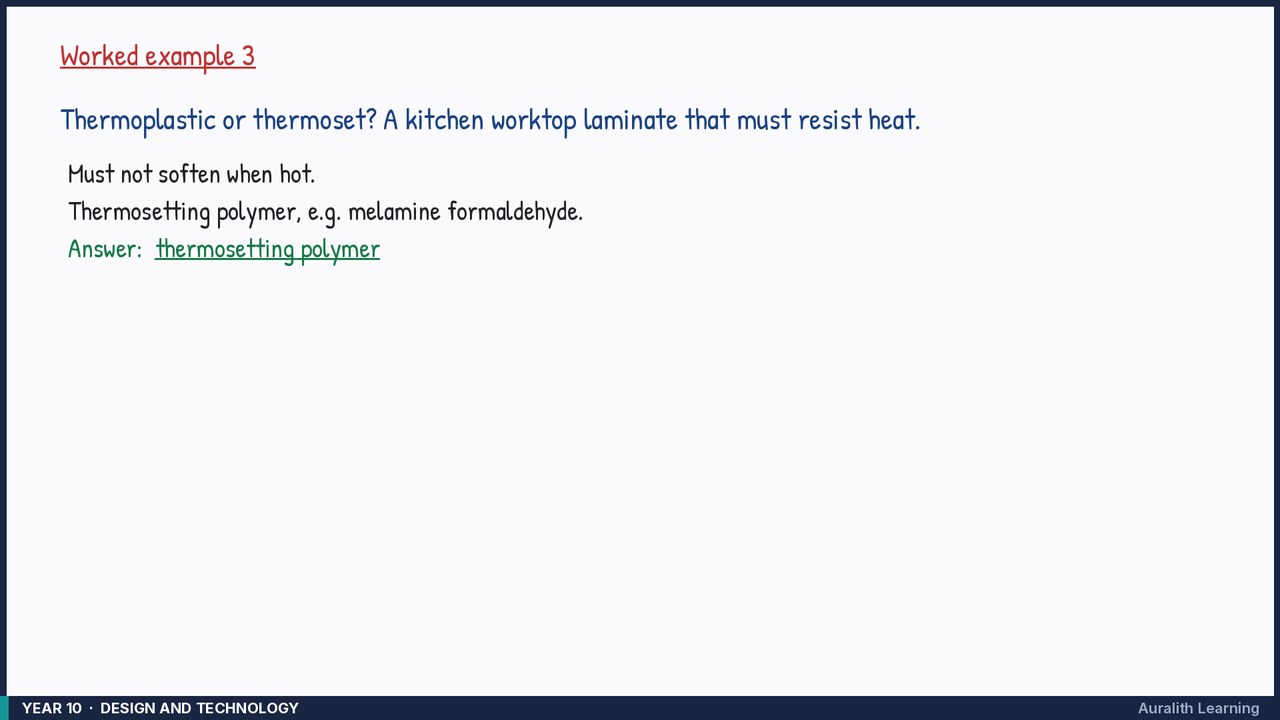
Thermoplastic or thermoset? A kitchen worktop laminate that must resist heat.
- Step 1: Must not soften when hot.
- Step 2: Thermosetting polymer, e.g. melamine formaldehyde.
Answer: thermosetting polymer