Year 10 (ages 14–15, Grade 9 in the US) · Citizenship · The UK and the world · Lesson 3
The UK, the EU, aid and international law
The UK's membership of the European Union from 1973 to its exit in 2020, the arguments made on each side of the 2016 referendum, how the UK gives international aid, and how international law and courts work.
Exam boards: this lesson matches the AQA and Pearson Edexcel GCSE citizenship courses. Check which course your school follows.
9-minute video lesson
Teaching, worked examples and 20 practice questions solved step by step.
Watch free for a monthWhat your child will learn
- Outline the UK's relationship with the EU
- Explain arguments made on both sides of the 2016 referendum
- Describe types of international aid
- Explain the role of international courts
The method
- Timeline: joined 1973, referendum 2016, left 31 January 2020.
- Arguments: present both sides fairly.
- Aid: emergency, development, bilateral, multilateral.
- International law: treaties and courts such as the ICC.
Key words: referendum, single market, sovereignty, international aid, International Criminal Court.
Worked examples
Worked examples from the lesson, with every step.
Question 1
When did the UK leave the EU?
- Step 1: Referendum, June 2016.
- Step 2: 31 January 2020.
Answer: 31 January 2020
Question 2
Give one argument made by the Leave campaign.
- Step 1: Sovereignty.
- Step 2: Parliament, not the EU, makes all UK laws.
Answer: more control over laws (sovereignty)
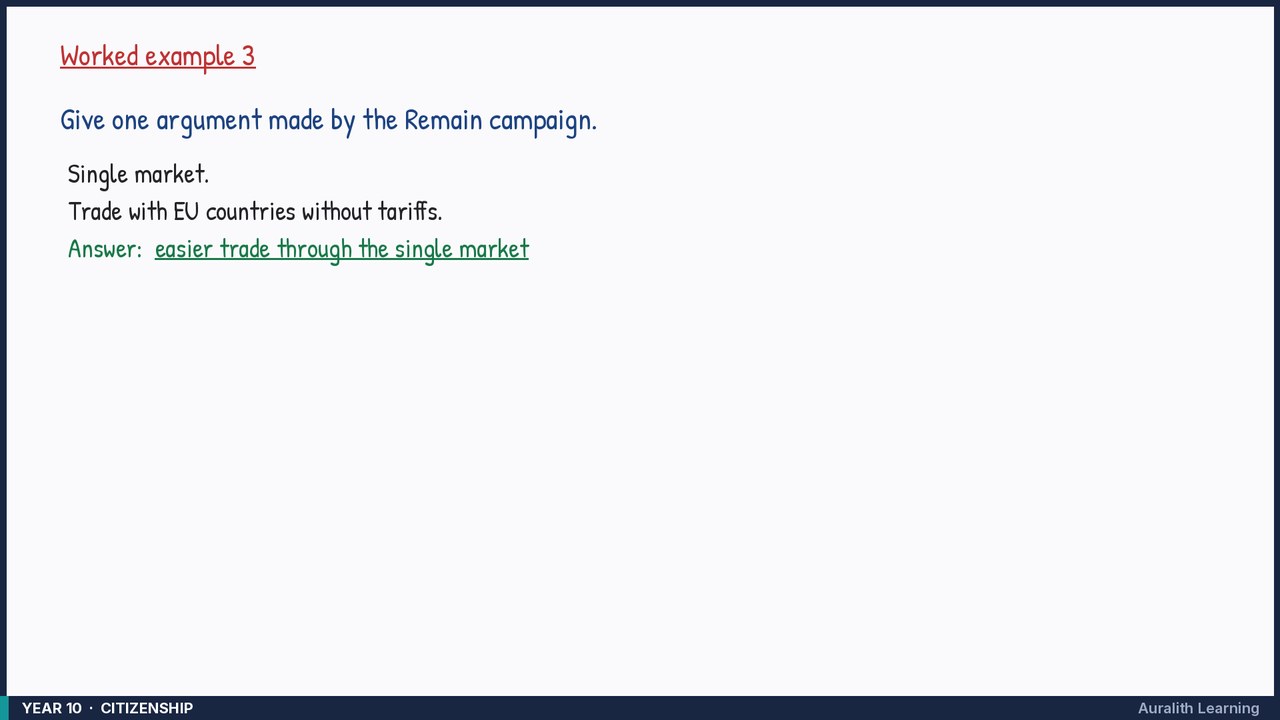
Question 3
Give one argument made by the Remain campaign.
- Step 1: Single market.
- Step 2: Trade with EU countries without tariffs.
Answer: easier trade through the single market