Year 10 (ages 14–15, Grade 9 in the US) · Citizenship · The UK and the world · Lesson 1
The UK and the United Nations
Why the United Nations was set up in 1945, its main parts (the General Assembly, Security Council, International Court of Justice and agencies), the UK's role as a permanent member of the Security Council, and debates about how effective the UN is.
Exam boards: this lesson matches the AQA and Pearson Edexcel GCSE citizenship courses. Check which course your school follows.
8-minute video lesson
Teaching, worked examples and 20 practice questions solved step by step.
Watch free for a monthWhat your child will learn
- Explain why the UN was created
- Describe the main parts of the UN
- Explain the UK's role on the Security Council
- Evaluate the UN's effectiveness
The method
- Purpose: peace, security, human rights, cooperation.
- Structure: General Assembly, Security Council, ICJ, agencies.
- UK role: one of five permanent members with a veto.
- Evaluate: successes and criticisms, then a judgement.
Key words: United Nations, Security Council, veto, peacekeeping, Universal Declaration of Human Rights.
Worked examples
Worked examples from the lesson, with every step.
Question 1
Give two aims of the UN.
- Step 1: Keep international peace.
- Step 2: Protect human rights.
Answer: peace and security; human rights
Question 2
What is a veto?
- Step 1: The power to block a decision.
- Step 2: The five permanent members.
Answer: the power of a permanent member to block a resolution
Question 3
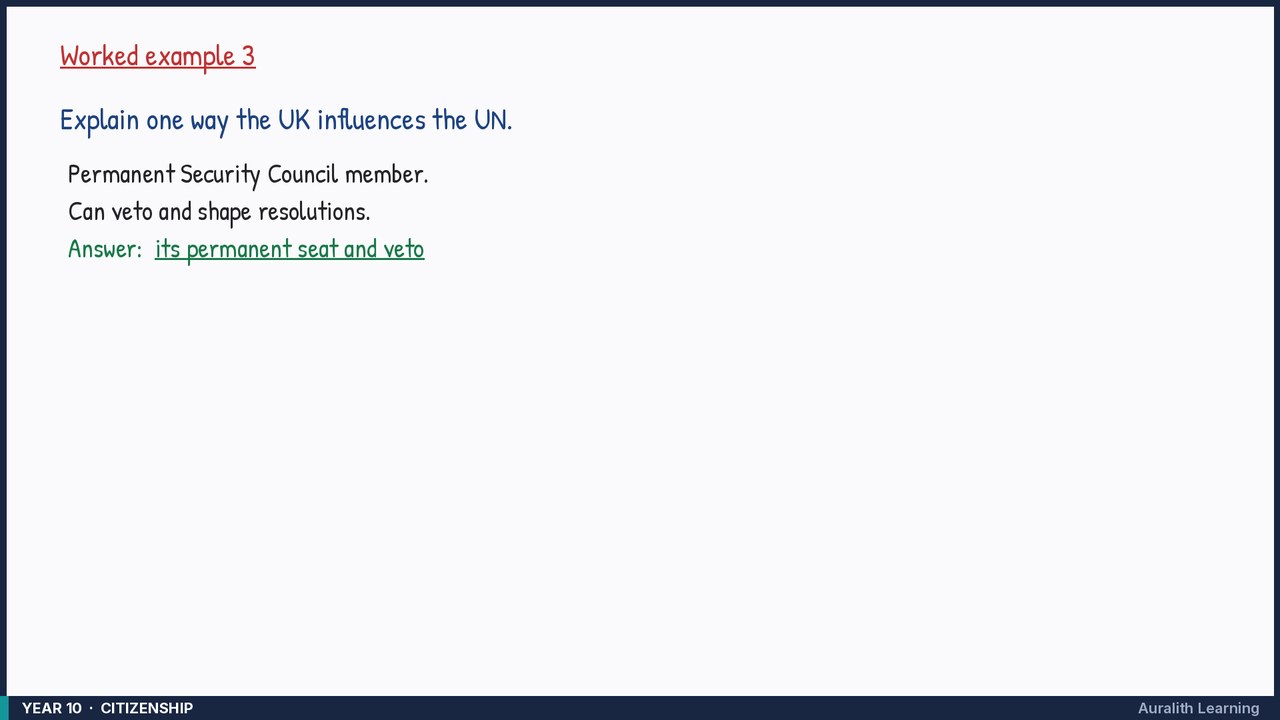
Explain one way the UK influences the UN.
- Step 1: Permanent Security Council member.
- Step 2: Can veto and shape resolutions.
Answer: its permanent seat and veto