Year 9 (ages 13–14, Grade 8 in the US) · Science · Bridge to GCSE · Lesson 2
Cells at GCSE level
Eukaryotic and prokaryotic cells, specialised cells and their adaptations, magnification calculations and microscopes.
18-minute video lesson
Teaching, worked examples and 20 practice questions solved step by step.
Watch free for a monthWhat your child will learn
- Compare eukaryotic and prokaryotic cells
- Explain cell adaptations
- Calculate magnification
- Compare microscopes
The method
- Nucleus? Eukaryotic. No nucleus? Prokaryotic.
- Link a cell's adaptation to its job.
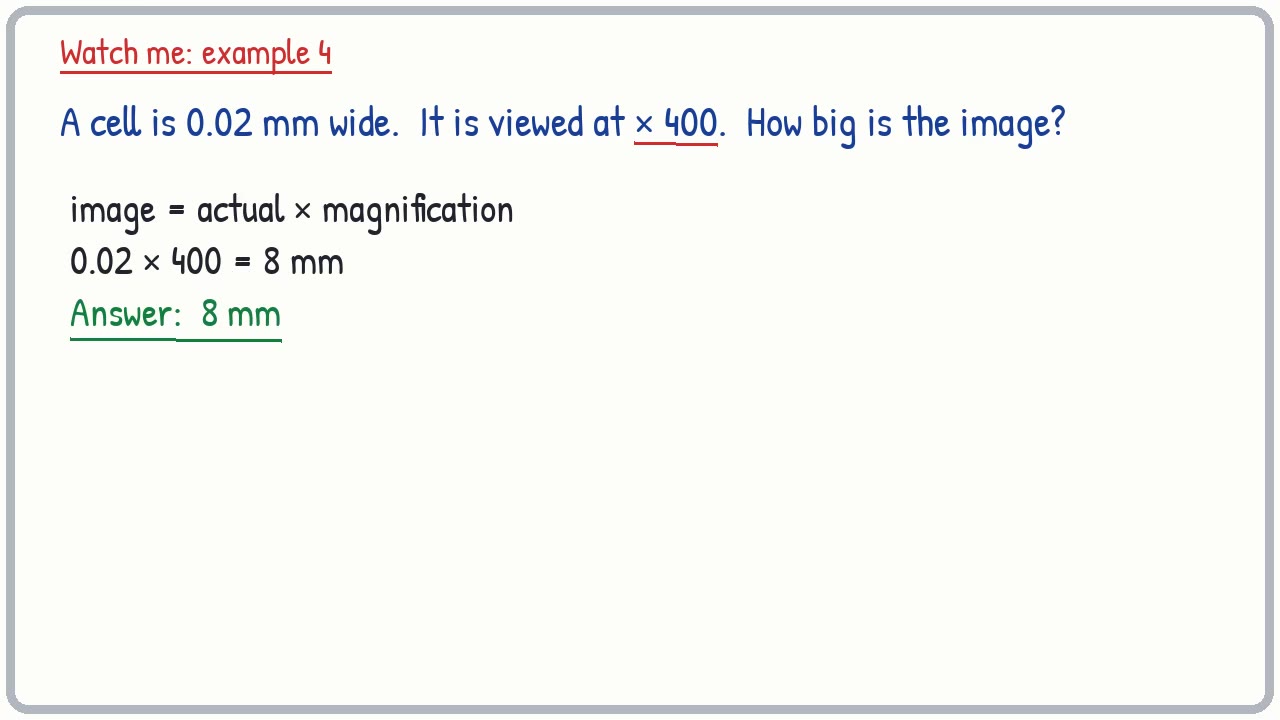
- Magnification = image ÷ actual.
- Match units first.
Key words: eukaryotic, prokaryotic, plasmid, specialised, magnification, resolution.
Worked examples
Worked examples from the lesson, with every step.
Question 1
An image is 10 mm long. The real object is 0.1 mm. What is the magnification?
- Step 1: magnification = image ÷ actual
- Step 2: 10 ÷ 0.1 = × 100
Answer: × 100
Question 2
An image is 40 mm long. The real object is 0.2 mm. What is the magnification?
- Step 1: magnification = image ÷ actual
- Step 2: 40 ÷ 0.2 = × 200
Answer: × 200
Question 3
An image is 30 mm long. The real object is 0.01 mm. What is the magnification?
- Step 1: magnification = image ÷ actual
- Step 2: 30 ÷ 0.01 = × 3000
Answer: × 3000