Year 9 (ages 13–14, Grade 8 in the US) · Maths · Using percentages · Lesson 3
Simple and compound interest
Calculate simple interest, compound interest and depreciation using multipliers and powers, compare simple and compound growth, and round money to the nearest penny.
27-minute video lesson
Teaching, worked examples and 20 practice questions solved step by step.
Watch free for a monthWhat your child will learn
- Calculate simple interest
- Calculate compound interest with powers
- Calculate depreciation
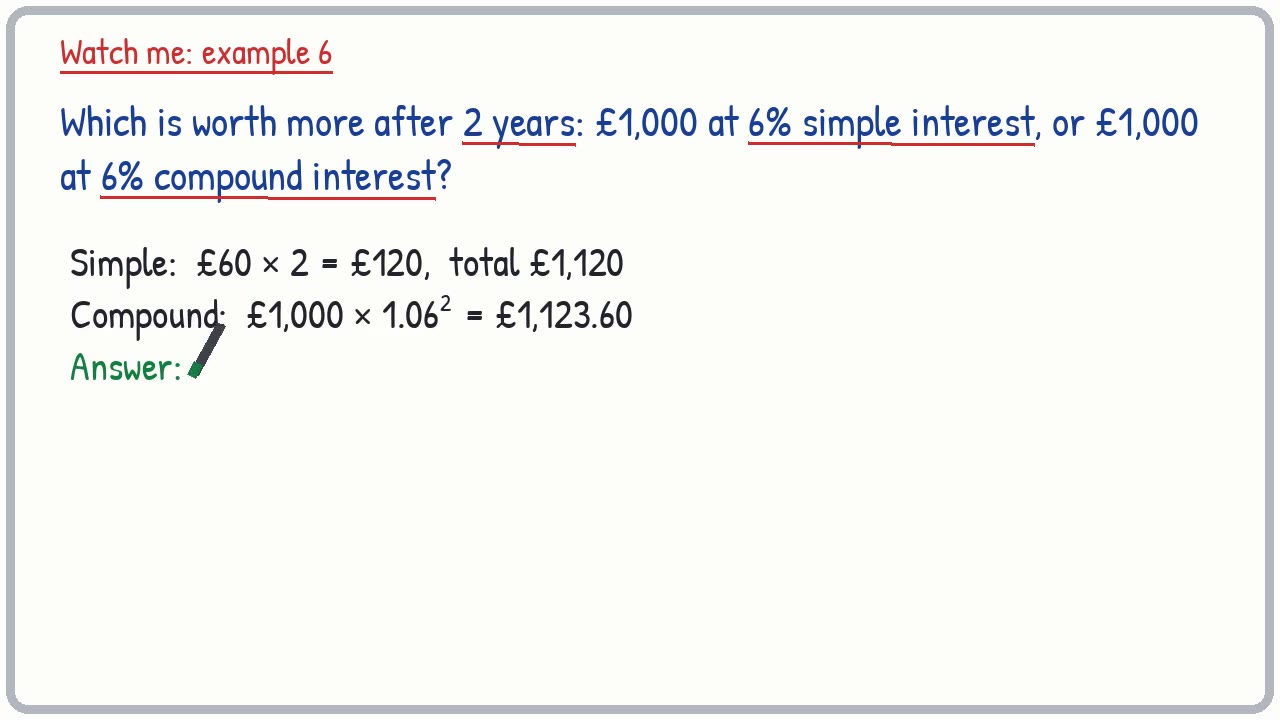
- Compare simple and compound growth
The method
- Simple: find 1 year's interest, × years, add on.
- Compound: find the multiplier.
- Amount = original × multiplierⁿ.
- Round money to the nearest penny at the end.
Key words: simple interest, compound interest, depreciation, multiplier, power, rate.
Worked examples
Worked examples from the lesson, with every step.
Question 1
£200 is invested at 5% simple interest per year. How much is in the account after 3 years?
- Step 1: 1 year: 5% of £200 = £10.00
- Step 2: 3 years: £10.00 × 3 = £30.00
- Step 3: Total = £200 + £30.00 = £230.00
Answer: £230.00
Question 2
£1,500 is invested at 2% simple interest per year. How much is in the account after 4 years?
- Step 1: 1 year: 2% of £1,500 = £30.00
- Step 2: 4 years: £30.00 × 4 = £120.00
- Step 3: Total = £1,500 + £120.00 = £1,620.00
Answer: £1,620.00
Question 3
£650 is invested at 4% simple interest per year. How much is in the account after 2 years?
- Step 1: 1 year: 4% of £650 = £26.00
- Step 2: 2 years: £26.00 × 2 = £52.00
- Step 3: Total = £650 + £52.00 = £702.00
Answer: £702.00