Year 7 (ages 11–12, Grade 6 in the US) · Maths · Powers and sets · Lesson 2
Sets and set notation
Describe sets with curly brackets and the universal set; use ∈ and ∉; find intersections, unions and complements; count elements with n( ); and use Venn diagrams.
23-minute video lesson
Teaching, worked examples and 20 practice questions solved step by step.
Watch free for a monthWhat your child will learn
- List the elements of a set from a rule
- Use the symbols ξ, ∈ and ∉
- Find A ∩ B, A ∪ B and A′
- Use Venn diagrams to solve problems
The method
- List each set from its rule.
- ∩ = in both (the overlap).
- ∪ = in either, or both.
- A′ = everything in ξ not in A.
Key words: set, element, universal set, intersection, union, complement.
Worked examples
Worked examples from the lesson, with every step.
Question 1
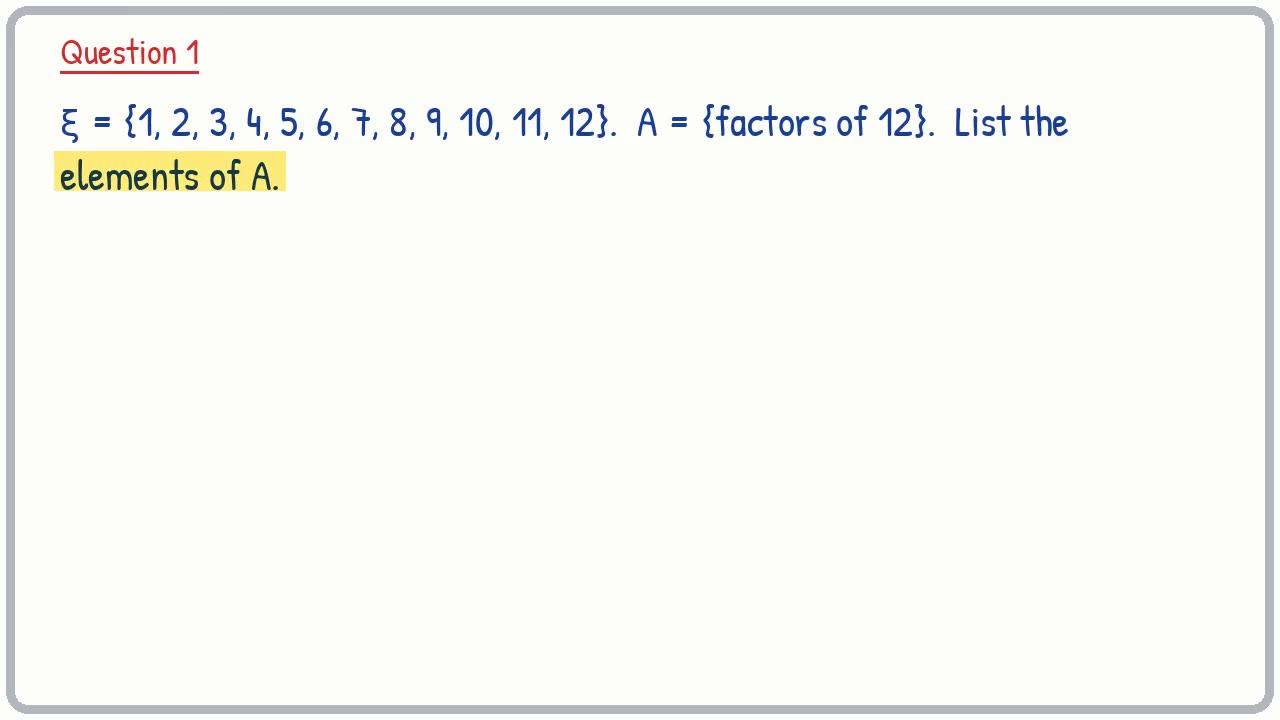
ξ = {1, 2, 3, 4, 5, 6, 7, 8, 9, 10, 11, 12}. A = {factors of 12}. List the elements of A.
- Step 1: ξ is everything we can choose from: 1 to 12
- Step 2: Pick out the factors of 12
- Step 3: A = {1, 2, 3, 4, 6, 12}
Answer: {1, 2, 3, 4, 6, 12}
Question 2
ξ = {1, 2, 3, 4, 5, 6, 7, 8, 9, 10, 11, 12, 13, 14, 15}. P = {prime numbers}. List the elements of P.
- Step 1: ξ is everything we can choose from: 1 to 15
- Step 2: Pick out the prime numbers
- Step 3: P = {2, 3, 5, 7, 11, 13}
Answer: {2, 3, 5, 7, 11, 13}
Question 3
ξ = {1, 2, 3, 4, 5, 6, 7, 8, 9, 10, 11, 12, 13, 14, 15, 16, 17, 18, 19, 20}. S = {square numbers}. List the elements of S.
- Step 1: ξ is everything we can choose from: 1 to 20
- Step 2: Pick out the square numbers
- Step 3: S = {1, 4, 9, 16}
Answer: {1, 4, 9, 16}