Year 11 (ages 15–16, Grade 10 in the US) · Science · Chemistry: chemical analysis · Lesson 1
Chemical analysis: tests for gases and ions, and chromatography
Pure substances and formulations, paper chromatography and Rf values, tests for hydrogen, oxygen, carbon dioxide and chlorine, flame tests for metal ions, and tests for carbonate, halide and sulfate ions.
Exam boards: this lesson matches the AQA and Pearson Edexcel GCSE science courses. Check which course your school follows.
8-minute video lesson
Teaching, worked examples and 20 practice questions solved step by step.
Watch free for a monthWhat your child will learn
- Distinguish pure substances and formulations
- Carry out and interpret chromatography
- Describe tests for common gases
- Describe tests for common ions
The method
- A pure substance has a sharp melting or boiling point.
- Rf = distance moved by spot ÷ distance moved by solvent.
- Gas tests: squeaky pop, relights, limewater, bleaches litmus.
- Ion tests: flame colours, precipitates.
Key words: pure substance, chromatography, Rf value, flame test, precipitate.
Worked examples
Worked examples from the lesson, with every step.
Question 1
A spot moves 3.0 cm while the solvent moves 6.0 cm. Calculate the Rf value.
- Step 1: Rf = spot ÷ solvent
- Step 2: 3.0 ÷ 6.0
Answer: 0.50
Question 2
Why is the start line drawn in pencil?
- Step 1: Ink would dissolve and move.
- Step 2: Graphite doesn't dissolve.
Answer: pencil doesn't dissolve in the solvent
Question 3
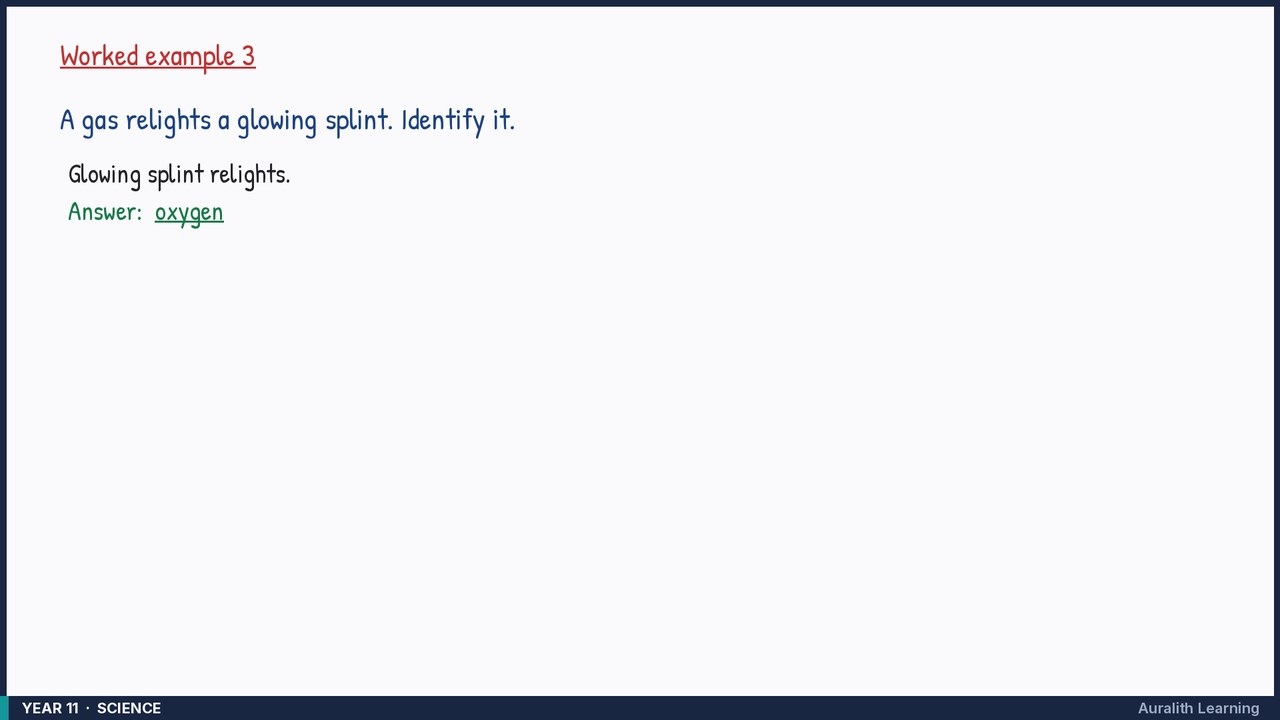
A gas relights a glowing splint. Identify it.
- Step 1: Glowing splint relights.
Answer: oxygen