Year 11 (ages 15–16, Grade 10 in the US) · Science · Biology: plants · Lesson 1
Photosynthesis and limiting factors
The word and symbol equations for photosynthesis, where it happens, how plants use glucose, and how light intensity, carbon dioxide concentration and temperature act as limiting factors, including the inverse square law for light.
Exam boards: this lesson matches the AQA and Pearson Edexcel GCSE science courses. Check which course your school follows.
9-minute video lesson
Teaching, worked examples and 20 practice questions solved step by step.
Watch free for a monthWhat your child will learn
- Write the equations for photosynthesis
- Describe how plants use glucose
- Explain limiting factors
- Interpret graphs of photosynthesis rate
The method
- Carbon dioxide + water → glucose + oxygen (light needed).
- Happens in chloroplasts; chlorophyll absorbs light.
- The factor in shortest supply limits the rate.
- On a graph, where the line levels off, another factor is limiting.
Key words: photosynthesis, chloroplast, chlorophyll, limiting factor, endothermic.
Worked examples
Worked examples from the lesson, with every step.
Question 1
Write the word equation for photosynthesis.
- Step 1: carbon dioxide + water
- Step 2: glucose + oxygen
Answer: carbon dioxide + water → glucose + oxygen
Question 2
A graph of rate against light intensity rises, then levels off. Explain the levelling off.
- Step 1: Light was limiting.
- Step 2: Now another factor, such as CO₂ or temperature, is limiting.
Answer: another factor has become limiting
Question 3
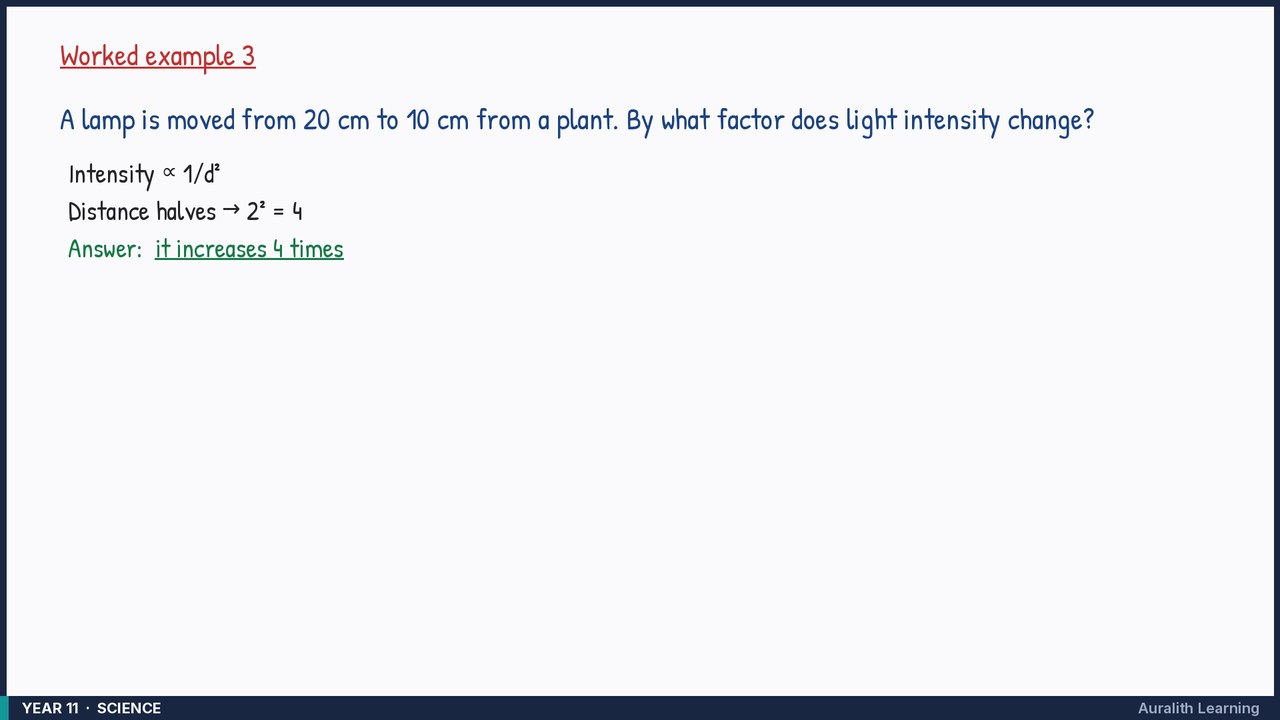
A lamp is moved from 20 cm to 10 cm from a plant. By what factor does light intensity change?
- Step 1: Intensity ∝ 1/d²
- Step 2: Distance halves → 2² = 4
Answer: it increases 4 times