Year 11 (ages 15–16, Grade 10 in the US) · RSHE and PSHE · Wellbeing and next steps · Lesson 2
Post-16 options: choosing your next step
The main routes after Year 11 — A levels, T levels, vocational qualifications such as BTECs, and apprenticeships — the rule in England that young people stay in education or training until 18, and how to research and make a good choice.
8-minute video lesson
Teaching, worked examples and 20 practice questions solved step by step.
Watch free for a monthWhat your child will learn
- Describe the main post-16 routes
- Explain the education and training rule in England
- Compare academic, technical and work-based routes
- Plan how to research and apply
The method
- A levels: academic, usually 3 subjects over 2 years.
- T levels: technical, with an industry placement.
- Vocational courses (e.g. BTECs): practical, career-focused.
- Apprenticeships: paid work plus training.
Key words: A level, T level, vocational, apprenticeship, UCAS.
Worked examples
Worked examples from the lesson, with every step.
Question 1
Can a 16-year-old in England leave education completely to work full-time with no training?
- Step 1: They must stay in education or training until 18.
- Step 2: Full-time work must include part-time study or training.
Answer: no — training or study must continue until 18
Question 2
Priya enjoys essays and exams and wants to study history at university. Which route might suit her?
- Step 1: Academic, exam-based.
- Step 2: A levels.
Answer: A levels
Question 3
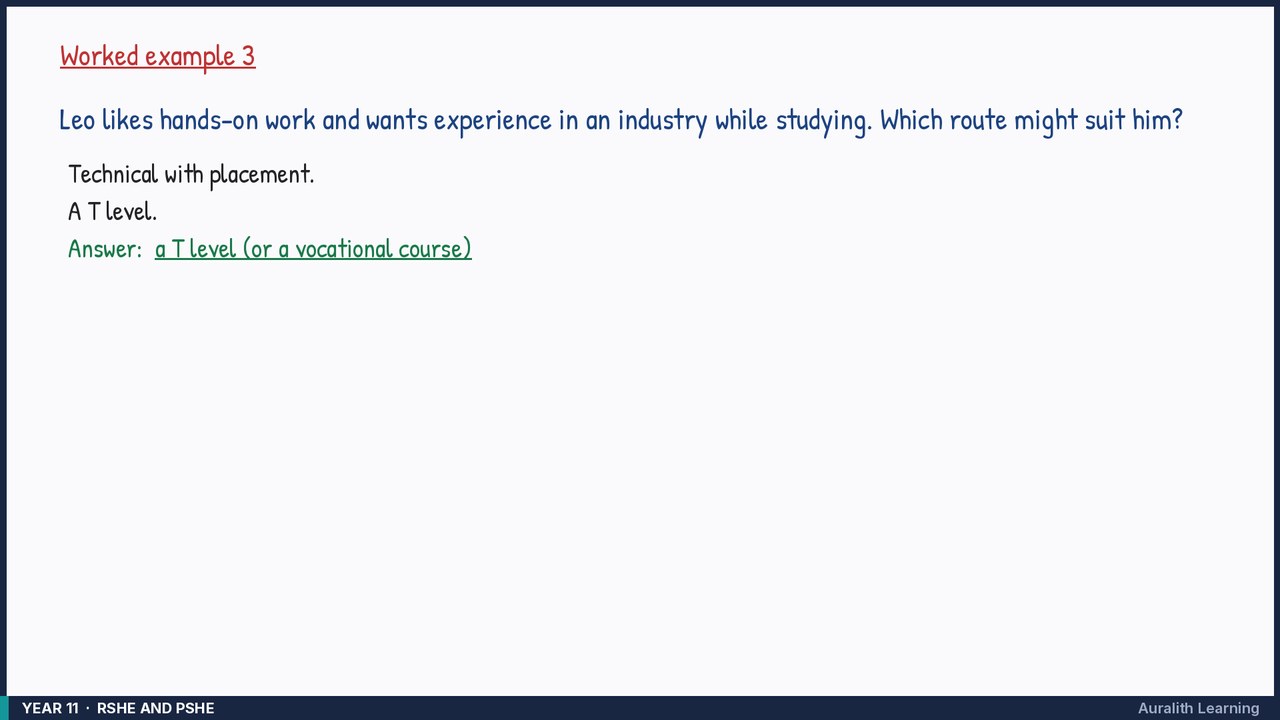
Leo likes hands-on work and wants experience in an industry while studying. Which route might suit him?
- Step 1: Technical with placement.
- Step 2: A T level.
Answer: a T level (or a vocational course)