Year 11 (ages 15–16, Grade 10 in the US) · Maths · Higher problem solving · Lesson 2
Iteration: solving equations step by step
Showing a root lies between two values using a change of sign, rearranging equations into the form x = g(x), using an iterative formula with a calculator to find approximate solutions, and knowing when an answer is accurate enough.
Exam boards: this lesson matches the AQA and Pearson Edexcel GCSE maths courses. Check which course your school follows.
10-minute video lesson
Teaching, worked examples and 20 practice questions solved step by step.
Watch free for a monthWhat your child will learn
- Show a root lies in an interval using a sign change
- Rearrange an equation into an iterative formula
- Use an iterative formula to find successive approximations
- Give a solution to a required accuracy
The method
- Substitute both ends of the interval: a change of sign means a root lies between.
- Rearrange to x = …, then write xₙ₊₁ = …
- Start with x₀ and feed each answer back in.
- Stop when answers agree to the accuracy needed.
Key words: iteration, iterative formula, root, change of sign, approximation.
Worked examples
Worked examples from the lesson, with every step.
Question 1
Show that x³ − 3x − 1 = 0 has a root between 1 and 2.
- Step 1: 1 − 3 − 1 = −3
- Step 2: 8 − 6 − 1 = 1
- Step 3: change of sign
Answer: −3 and 1: sign change, so a root lies between 1 and 2
Question 2
Show that x³ − 3x − 1 = 0 can be rearranged to x = ∛(3x + 1).
- Step 1: x³ = 3x + 1
- Step 2: x = ∛(3x + 1)
Answer: x = ∛(3x + 1)
Question 3
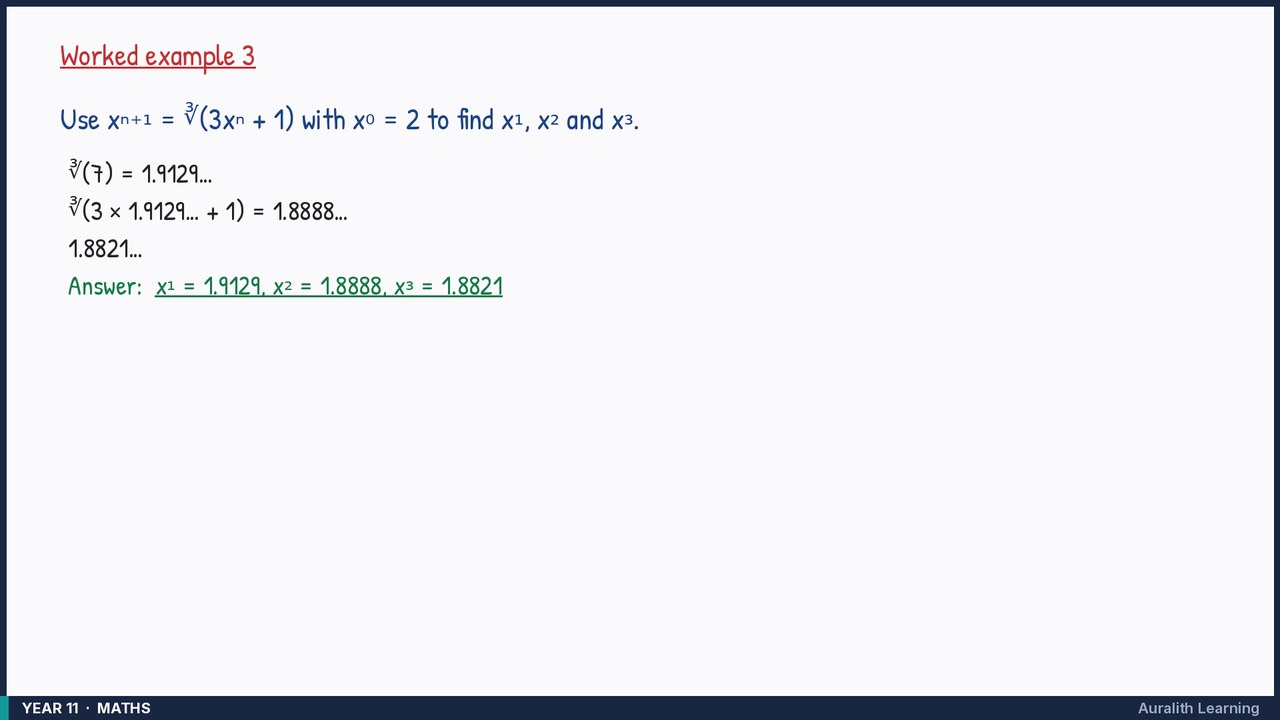
Use xₙ₊₁ = ∛(3xₙ + 1) with x₀ = 2 to find x₁, x₂ and x₃.
- Step 1: ∛(7) = 1.9129…
- Step 2: ∛(3 × 1.9129… + 1) = 1.8888…
- Step 3: 1.8821…
Answer: x₁ = 1.9129, x₂ = 1.8888, x₃ = 1.8821