Year 11 (ages 15–16, Grade 10 in the US) · Maths · Higher graphs · Lesson 1
Graph transformations
Translating and reflecting graphs using function notation: y = f(x) + a, y = f(x + a), y = −f(x) and y = f(−x), finding how points and turning points move, and applying transformations to quadratic and trigonometric graphs.
Exam boards: this lesson matches the AQA and Pearson Edexcel GCSE maths courses. Check which course your school follows.
10-minute video lesson
Teaching, worked examples and 20 practice questions solved step by step.
Watch free for a monthWhat your child will learn
- Translate graphs using f(x) + a and f(x + a)
- Reflect graphs using −f(x) and f(−x)
- Find the image of a point after a transformation
- Describe transformations of familiar graphs
The method
- f(x) + a: move up by a.
- f(x + a): move LEFT by a (inside the bracket works the opposite way).
- −f(x): reflect in the x-axis (y changes sign).
- f(−x): reflect in the y-axis (x changes sign).
Key words: transformation, translation, reflection, function, turning point.
Worked examples
Worked examples from the lesson, with every step.
Question 1
The point (4, 1) lies on y = f(x). Find its image on y = f(x) − 3.
- Step 1: Outside: y changes
- Step 2: Down 3
Answer: (4, −2)
Question 2
The point (4, 1) lies on y = f(x). Find its image on y = f(x + 2).
- Step 1: Inside: x changes, opposite direction
- Step 2: Left 2
Answer: (2, 1)
Question 3
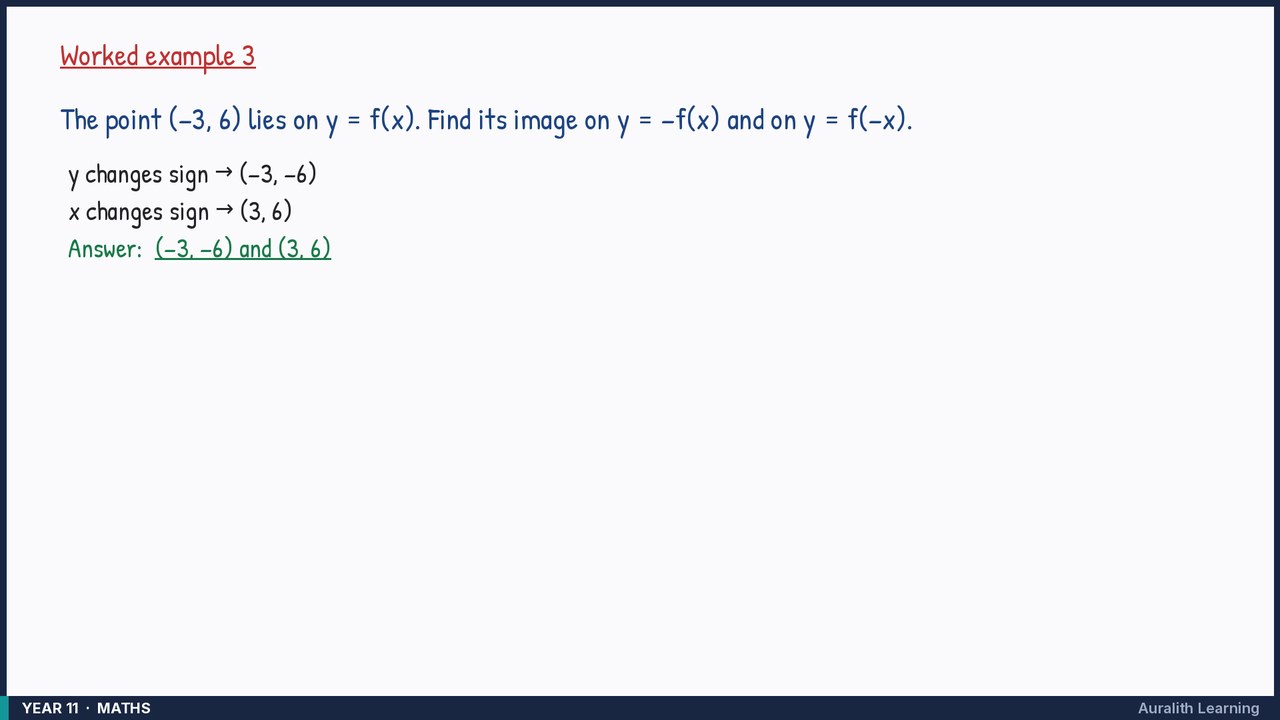
The point (−3, 6) lies on y = f(x). Find its image on y = −f(x) and on y = f(−x).
- Step 1: y changes sign → (−3, −6)
- Step 2: x changes sign → (3, 6)
Answer: (−3, −6) and (3, 6)