Year 11 (ages 15–16, Grade 10 in the US) · Languages · GCSE themes, part 2 and exam skills · Lesson 1
Holidays and travel: the perfect tense
Describing past holidays in French using the perfect tense with avoir and être, transport and accommodation vocabulary, and adding opinions to make answers more detailed.
Exam boards: this lesson matches the AQA and Pearson Edexcel GCSE languages courses. Check which course your school follows.
8-minute video lesson
Teaching, worked examples and 20 practice questions solved step by step.
Watch free for a monthWhat your child will learn
- Form the perfect tense with avoir
- Form the perfect tense with être and make agreements
- Use transport and accommodation vocabulary
- Give opinions about a past holiday
The method
- Perfect tense = avoir/être + past participle.
- Most verbs use avoir: «j'ai visité».
- Movement verbs use être: «je suis allé(e)».
- With être, the participle agrees: add -e for feminine, -s for plural.
Key words: perfect tense, past participle, auxiliary, agreement, opinion.
Worked examples
Worked examples from the lesson, with every step.
Question 1
Translate: I visited Paris.
- Step 1: «visiter» uses avoir
- Step 2: «j'ai visité»
Answer: «J'ai visité Paris.»
Question 2
Translate: We went to Spain by plane.
- Step 1: «aller» uses être: «nous sommes allés»
- Step 2: «en Espagne en avion»
Answer: «Nous sommes allés en Espagne en avion.»
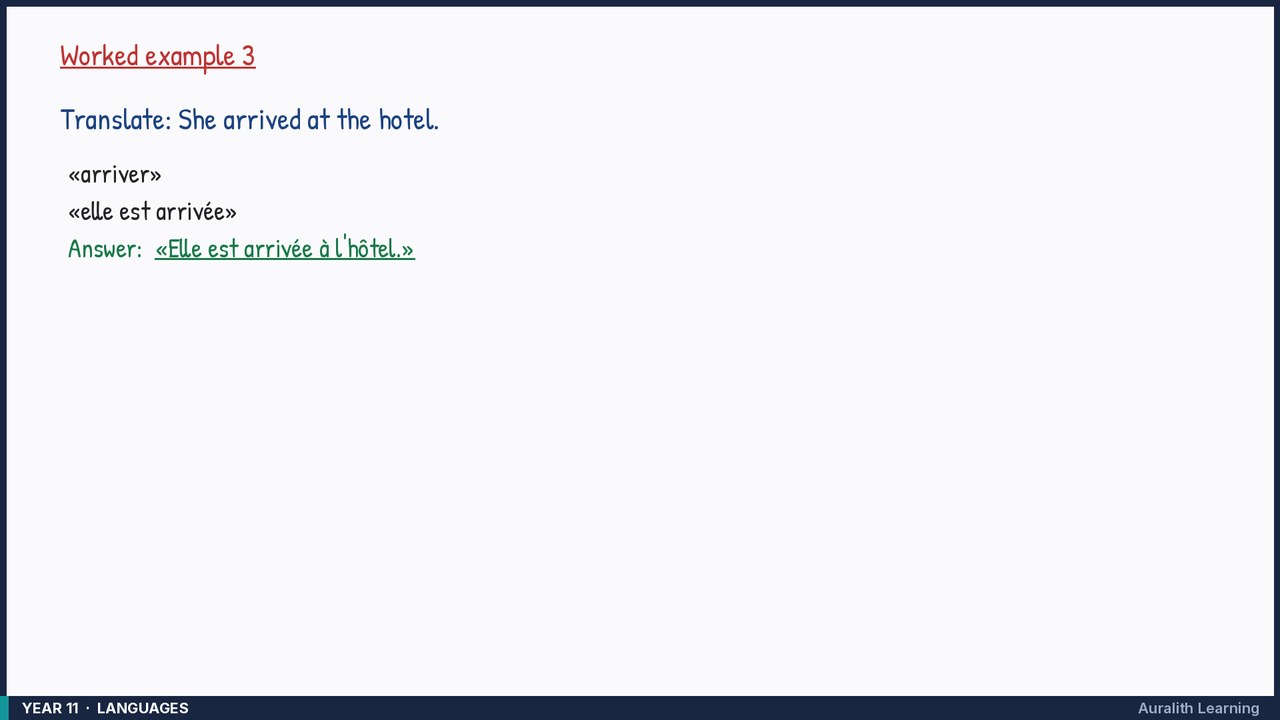
Question 3
Translate: She arrived at the hotel.
- Step 1: «arriver»
- Step 2: «elle est arrivée»
Answer: «Elle est arrivée à l'hôtel.»