Year 11 (ages 15–16, Grade 10 in the US) · English · Unseen poetry · Lesson 2
Unseen poetry: comparing two poems
How to compare the methods two poets use to present a similar idea: finding the shared theme, comparing language, structure and form, and writing concise comparative paragraphs, using two original poems written for this lesson.
Exam boards: this lesson matches the AQA GCSE English courses. Check which course your school follows.
8-minute video lesson
Teaching, worked examples and 20 practice questions solved step by step.
Watch free for a monthWhat your child will learn
- Identify the shared theme of two poems
- Compare language methods
- Compare structure and form
- Write concise comparative paragraphs
The method
- Find the shared idea in both poems.
- Compare methods, not just meanings.
- Use connectives: similarly, whereas, in contrast.
- Keep it concise: about 2 comparative paragraphs.
Key words: compare, contrast, method, free verse, imagery.
Worked examples
Worked examples from the lesson, with every step.
Question 1
What is the shared theme of the two poems?
- Step 1: A loyal lighthouse, forgotten.
- Step 2: A nurse, unseen at night.
Answer: unseen, loyal care
Question 2
Compare the form of the two poems.
- Step 1: Rhyming couplets: regular, like waves.
- Step 2: Free verse: natural, like quiet speech.
Answer: A is regular and rhymed, whereas B is free verse
Question 3
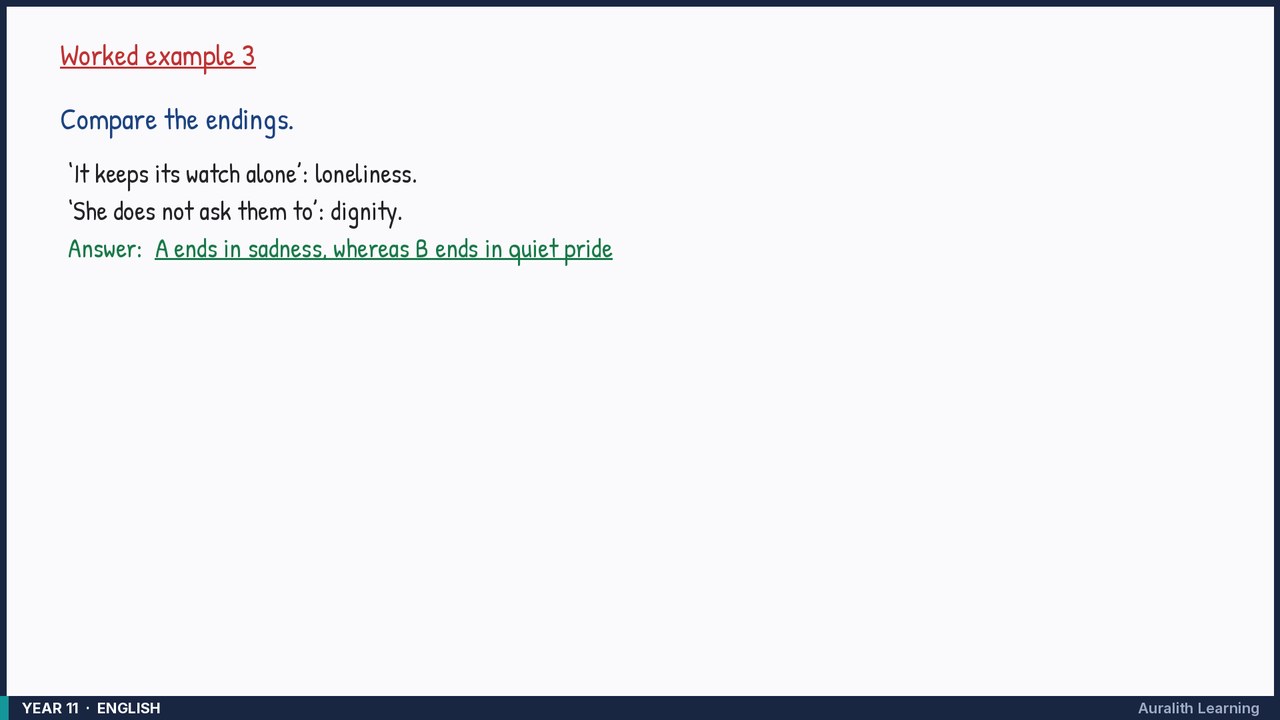
Compare the endings.
- Step 1: ‘It keeps its watch alone’: loneliness.
- Step 2: ‘She does not ask them to’: dignity.
Answer: A ends in sadness, whereas B ends in quiet pride