Year 11 (ages 15–16, Grade 10 in the US) · English · Transactional writing · Lesson 2
Transactional writing: speeches
How to write a persuasive speech for Language Paper 2: addressing a live audience, using spoken rhetorical devices, structuring for impact, and ending powerfully.
Exam boards: this lesson matches the AQA and Pearson Edexcel GCSE English courses. Check which course your school follows.
8-minute video lesson
Teaching, worked examples and 20 practice questions solved step by step.
Watch free for a monthWhat your child will learn
- Use speech conventions
- Use rhetorical devices for a listening audience
- Structure a speech for impact
- Write a powerful ending
The method
- Greet the audience directly.
- Use ‘we’ and ‘you’ to involve listeners.
- Use repetition, triples and questions — they work aloud.
- End with a memorable call to action.
Key words: rhetoric, inclusive pronoun, repetition, anaphora, audience.
Worked examples
Worked examples from the lesson, with every step.
Question 1
Write a speech opening for an assembly about kindness.
- Step 1: Good morning, everyone.
- Step 2: Think of the last time someone was kind to you. How did it feel?
Answer: a greeting followed by a question hook
Question 2
Use anaphora in a sentence about the environment.
- Step 1: Start each clause the same way.
- Step 2: We can recycle. We can reuse. We can change.
Answer: ‘We can recycle. We can reuse. We can change.’
Question 3
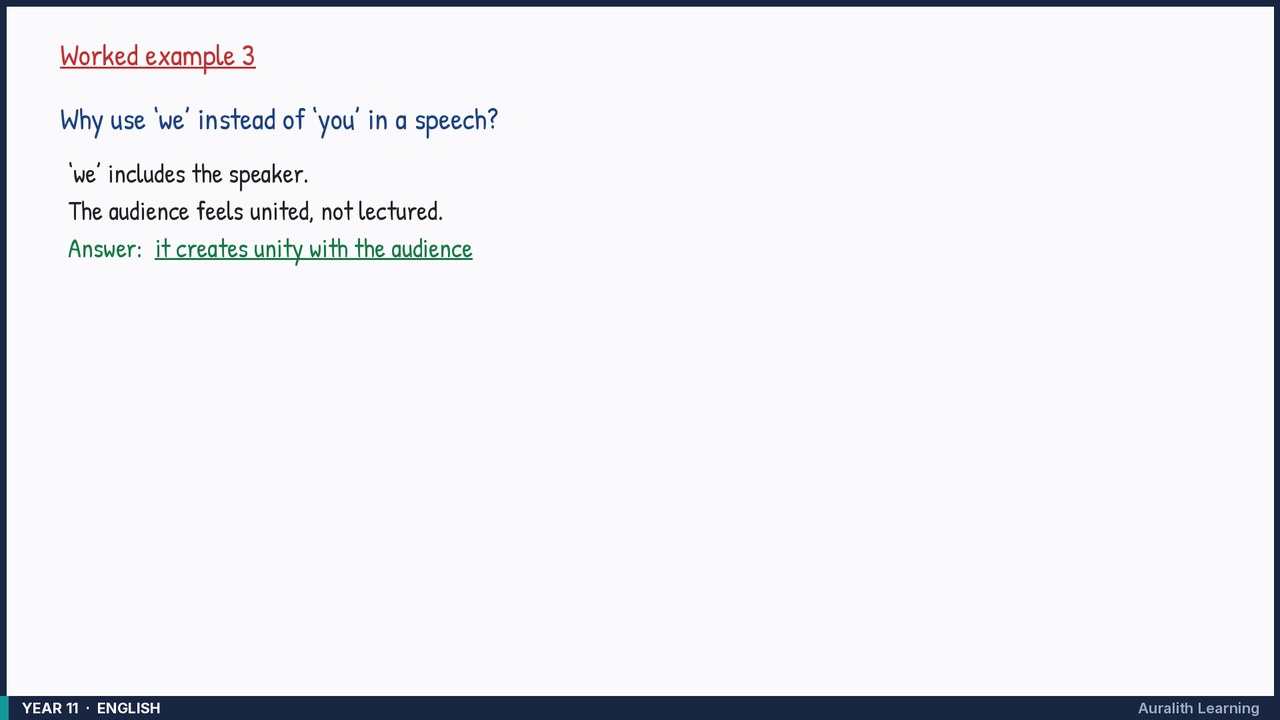
Why use ‘we’ instead of ‘you’ in a speech?
- Step 1: ‘we’ includes the speaker.
- Step 2: The audience feels united, not lectured.
Answer: it creates unity with the audience