Year 11 (ages 15–16, Grade 10 in the US) · Art and design · Externally set assignment · Lesson 1
The externally set assignment: choosing and developing a starting point
How the externally set assignment works, how to choose a starting point from the exam paper, and how to build a strong preparatory sketchbook through research, recording and experimentation.
Exam boards: this lesson matches the AQA and Pearson Edexcel GCSE art and design courses. Check which course your school follows.
8-minute video lesson
Teaching, worked examples and 20 practice questions solved step by step.
Watch free for a monthWhat your child will learn
- Explain how the externally set assignment works
- Choose a starting point that suits you
- Plan preparatory work for all four objectives
- Research artists purposefully
The method
- Read every starting point; mind-map two or three.
- Choose one you can explore personally.
- Research 2–3 artists; respond to their work.
- Record, experiment and annotate — covering AO1 to AO4.
Key words: externally set assignment, starting point, preparatory period, artist research, annotation.
Worked examples
Worked examples from the lesson, with every step.
Question 1
Why read every starting point before choosing?
- Step 1: One may suit your interests much better.
- Step 2: Some offer more first-hand sources.
Answer: to find the one you can explore best
Question 2
What makes a good starting point choice?
- Step 1: It links to your interests.
- Step 2: You can gather first-hand sources.
Answer: personal interest and access to sources
Question 3
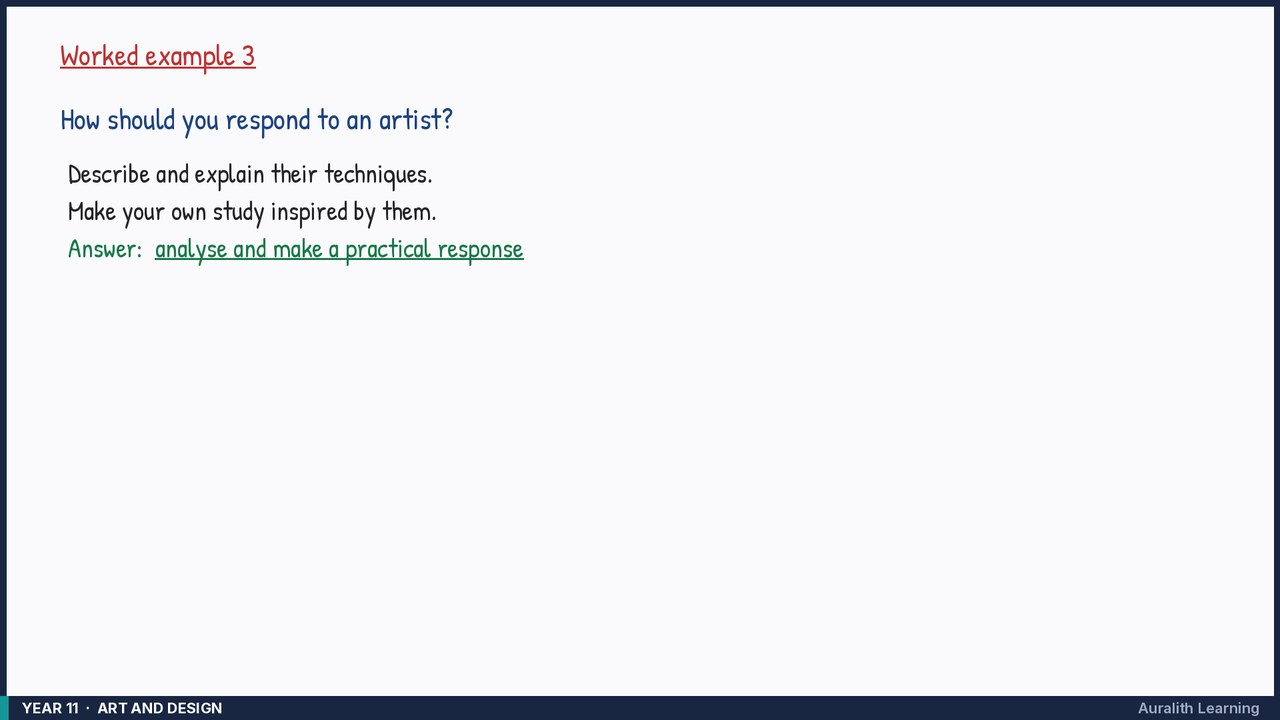
How should you respond to an artist?
- Step 1: Describe and explain their techniques.
- Step 2: Make your own study inspired by them.
Answer: analyse and make a practical response