Year 10 (ages 14–15, Grade 9 in the US) · Maths · Expressions and formulae · Lesson 2
Factorising
Factorise expressions by taking out the highest common factor, factorise quadratics of the form x² + bx + c, and use the difference of two squares.
Exam boards: this lesson matches the AQA and Pearson Edexcel GCSE maths courses. Check which course your school follows.
9-minute video lesson
Teaching, worked examples and 20 practice questions solved step by step.
Watch free for a monthWhat your child will learn
- Factorise with a common factor
- Factorise x² + bx + c
- Use the difference of two squares
- Factorise fully
The method
- Take out any common factor first.
- x² + bx + c: two numbers that multiply to c and add to b.
- Difference of two squares: a² − b² = (a + b)(a − b).
- Check by expanding.
Key words: factorise, common factor, quadratic, difference of two squares, bracket.
Worked examples
Worked examples from the lesson, with every step.
Question 1
Factorise fully 5x + 20.
- Step 1: 5
Answer: 5(x + 4)
Question 2
Factorise fully 8x² − 12x.
- Step 1: 4x
Answer: 4x(2x − 3)
Question 3
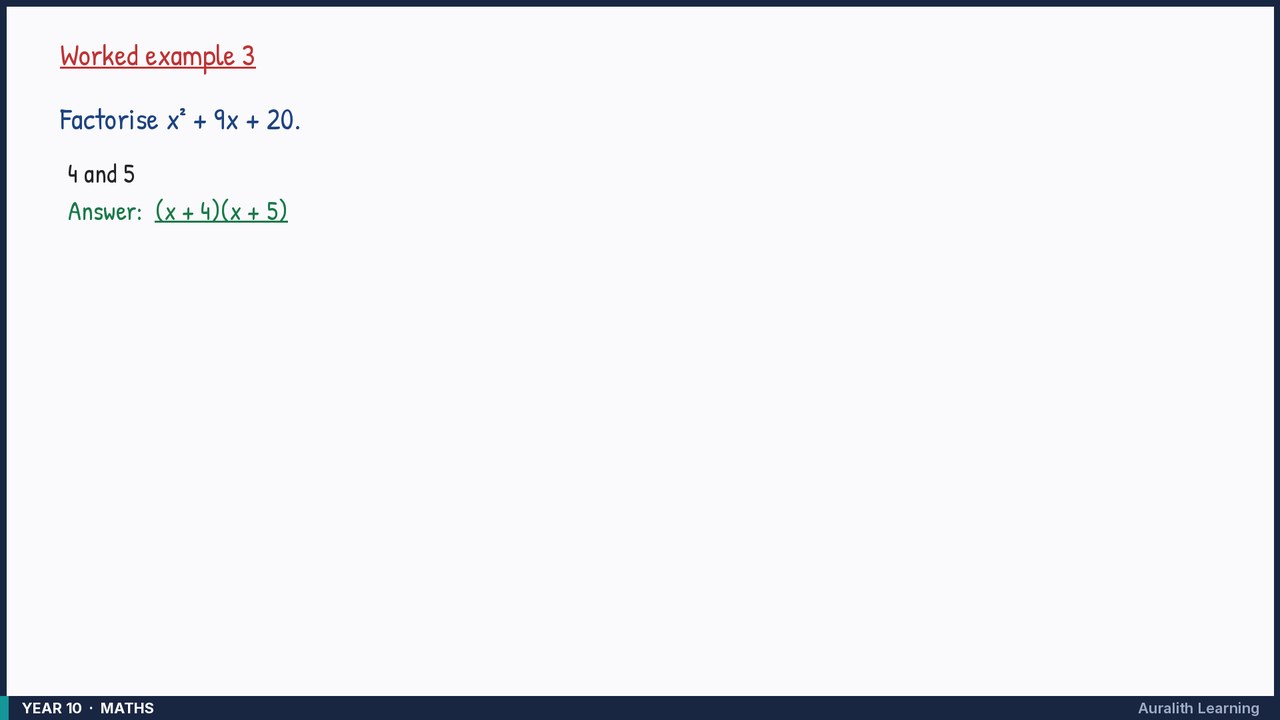
Factorise x² + 9x + 20.
- Step 1: 4 and 5
Answer: (x + 4)(x + 5)