Year 10 (ages 14–15, Grade 9 in the US) · Maths · Growth and decay · Lesson 1
Compound interest
Calculate compound interest using multipliers and powers, compare with simple interest, and find rates and numbers of years (made-up rates).
Exam boards: this lesson matches the AQA and Pearson Edexcel GCSE maths courses. Check which course your school follows.
10-minute video lesson
Teaching, worked examples and 20 practice questions solved step by step.
Watch free for a monthWhat your child will learn
- Find percentage multipliers
- Use P × multiplier^n
- Compare simple and compound interest
- Find the number of years
The method
- Multiplier = 1 + r/100.
- Amount = original × multiplierⁿ.
- Interest = amount − original.
- Round money to 2 d.p. at the end.
Key words: compound interest, simple interest, multiplier, exponential, principal.
Worked examples
Worked examples from the lesson, with every step.
Question 1
£1,000 is invested at 3% compound interest per year. Find its value after 2 years.
- Step 1: 1.03
- Step 2: 1000 × 1.03²
Answer: £1,060.90
Question 2
£4,000 is invested at 2% compound interest per year. Find its value after 3 years.
- Step 1: 4000 × 1.02³
Answer: £4,244.83
Question 3
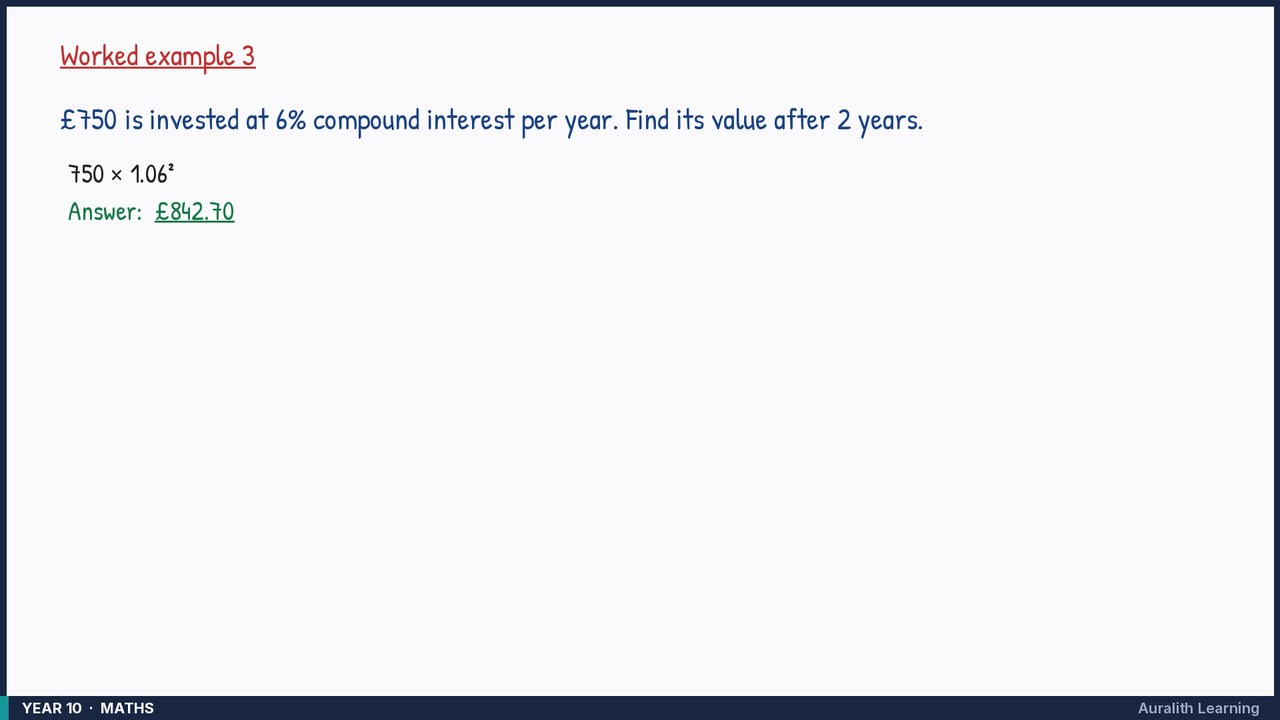
£750 is invested at 6% compound interest per year. Find its value after 2 years.
- Step 1: 750 × 1.06²
Answer: £842.70