Year 10 (ages 14–15, Grade 9 in the US) · Maths · Number skills for GCSE · Lesson 2
Error intervals and bounds
Find error intervals and upper and lower bounds for rounded and truncated values, write them as inequalities, and use bounds in simple problems.
Exam boards: this lesson matches the AQA and Pearson Edexcel GCSE maths courses. Check which course your school follows.
30-minute video lesson
Teaching, worked examples and 20 practice questions solved step by step.
Watch free for a monthWhat your child will learn
- Find upper and lower bounds
- Write error intervals
- Handle truncated values
- Use bounds in problems
The method
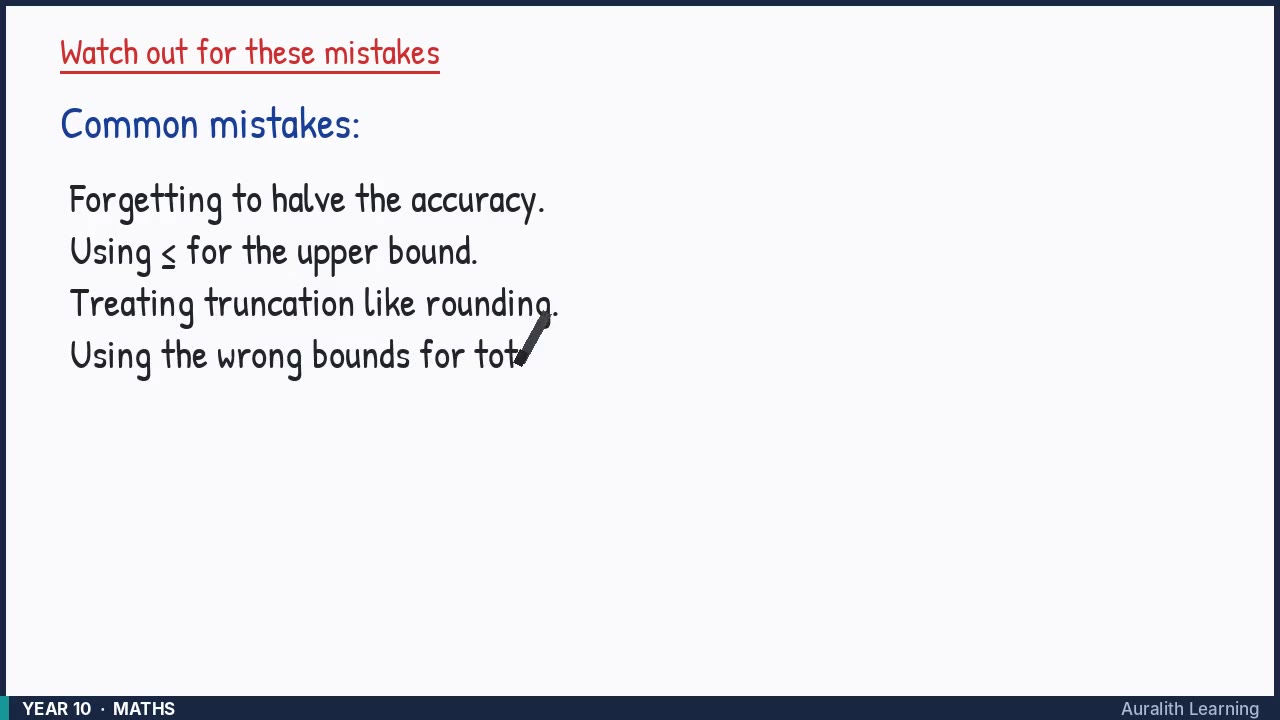
- Halve the accuracy.
- Lower bound: subtract. Upper bound: add.
- Write lower ≤ x < upper.
- Truncated: from the number up to the next whole unit.
Key words: error interval, upper bound, lower bound, truncate, accuracy.
Worked examples
Worked examples from the lesson, with every step.
Question 1
A measurement x is 12 cm, rounded to the nearest cm. Write the error interval for x.
- Step 1: Half of 1 = 0.5
- Step 2: Lower bound: 12 − 0.5 = 11.5
- Step 3: Upper bound: 12 + 0.5 = 12.5
- Step 4: Lower bound included (≤); upper bound not (<)
Answer: 11.5 ≤ x < 12.5
Question 2
A measurement x is 60 kg, rounded to the nearest 10 kg. Write the error interval for x.
- Step 1: Half of 10 = 5
- Step 2: Lower bound: 60 − 5 = 55
- Step 3: Upper bound: 60 + 5 = 65
- Step 4: Lower bound included (≤); upper bound not (<)
Answer: 55 ≤ x < 65
Question 3
A measurement x is 300 g, rounded to the nearest 100 g. Write the error interval for x.
- Step 1: Half of 100 = 50
- Step 2: Lower bound: 300 − 50 = 250
- Step 3: Upper bound: 300 + 50 = 350
- Step 4: Lower bound included (≤); upper bound not (<)
Answer: 250 ≤ x < 350