Year 10 (ages 14–15, Grade 9 in the US) · English · Poetry anthology cluster · Lesson 1
How to compare two poems
The anthology question on Paper 2: what it asks, how to choose a second poem, and how to compare ideas, language, form, structure and context, using A Poison Tree and The Man He Killed.
Exam boards: this lesson matches the Pearson Edexcel GCSE English courses. Check which course your school follows.
9-minute video lesson
Teaching, worked examples and 20 practice questions solved step by step.
Watch free for a monthWhat your child will learn
- Unpick the anthology question
- Choose a good second poem
- Compare ideas, methods and context
- Use comparative connectives
The method
- Find the theme in the question.
- Choose a second poem that links clearly.
- Compare a similarity, then a difference.
- Use connectives: both, whereas, similarly, however.
Key words: compare, cluster, anthology, connective, context.
Worked examples
Worked examples from the lesson, with every step.
Question 1
Compare how conflict between individuals is presented in A Poison Tree and one other poem. What is the theme?
- Step 1: Find the words after ‘how’.
- Step 2: Conflict between two people.
Answer: conflict between individuals
Question 2
Find a similarity in ideas between the two poems.
- Step 1: A friend becomes a foe through hidden anger.
- Step 2: A stranger becomes a foe because of war.
Answer: both show people becoming enemies for little real reason
Question 3
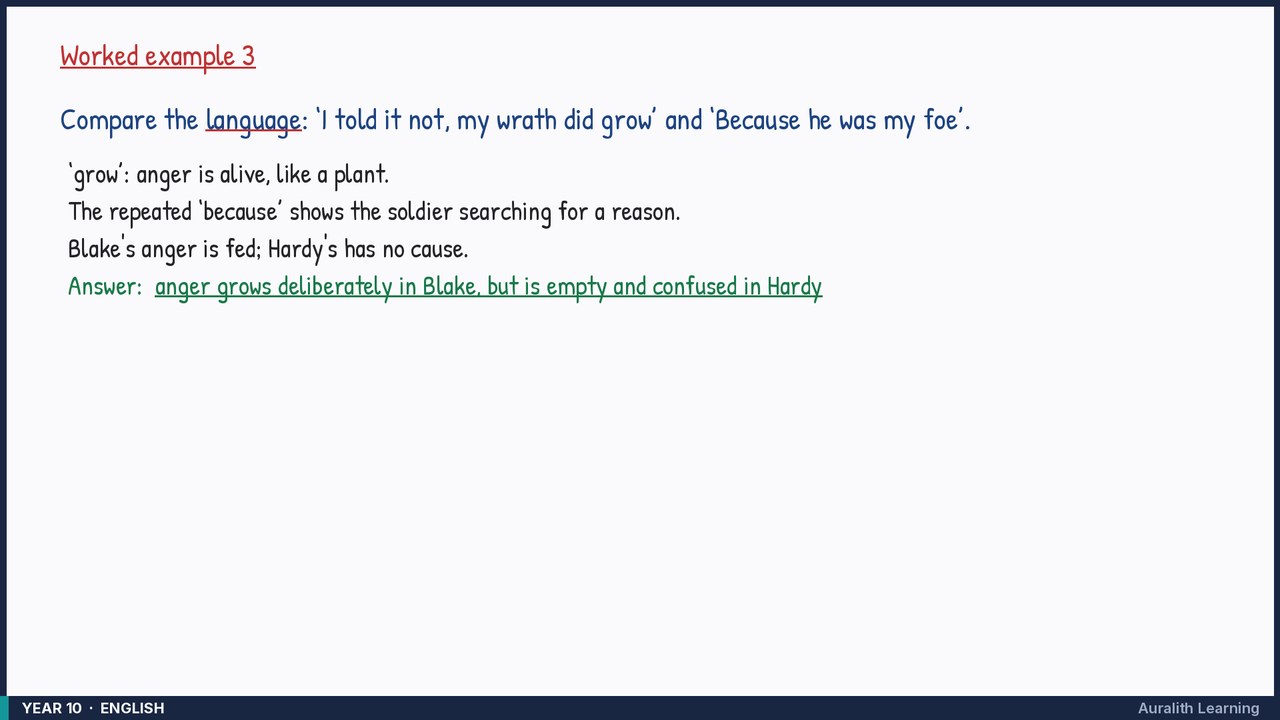
Compare the language: ‘I told it not, my wrath did grow’ and ‘Because he was my foe’.
- Step 1: ‘grow’: anger is alive, like a plant.
- Step 2: The repeated ‘because’ shows the soldier searching for a reason.
- Step 3: Blake's anger is fed; Hardy's has no cause.
Answer: anger grows deliberately in Blake, but is empty and confused in Hardy