Year 10 (ages 14–15, Grade 9 in the US) · English · Macbeth · Lesson 9
The whole-play question: part (b)
How to answer part (b) of the Macbeth question: track a theme across the whole play, choose moments from different acts, and link them to Jacobean context, using deception as the theme.
Exam boards: this lesson matches the Pearson Edexcel GCSE English courses. Check which course your school follows.
10-minute video lesson
Teaching, worked examples and 20 practice questions solved step by step.
Watch free for a monthWhat your child will learn
- Unpick the part (b) question
- Choose moments from across the play
- Use context to support a point
- Write a whole-play paragraph
The method
- Underline the theme and the bullet points.
- Pick three or four moments from different acts.
- Make a point about each one, with a short quotation.
- Link at least one point to context.
Key words: theme, AO1, AO3, context, equivocation.
Worked examples
Worked examples from the lesson, with every step.
Question 1
Explain the importance of ambition elsewhere in the play. What must you write about?
- Step 1: Find the theme in the question.
- Step 2: ‘Elsewhere’: not the extract you were given.
Answer: ambition, in other parts of the play
Question 2
Choose three moments that show deception from different acts.
- Step 1: Lady Macbeth: ‘be the serpent under't’
- Step 2: Donalbain: ‘daggers in men's smiles’
- Step 3: Witches ‘palter with us in a double sense’
Answer: Acts 1, 2 and 5 cover the play
Question 3
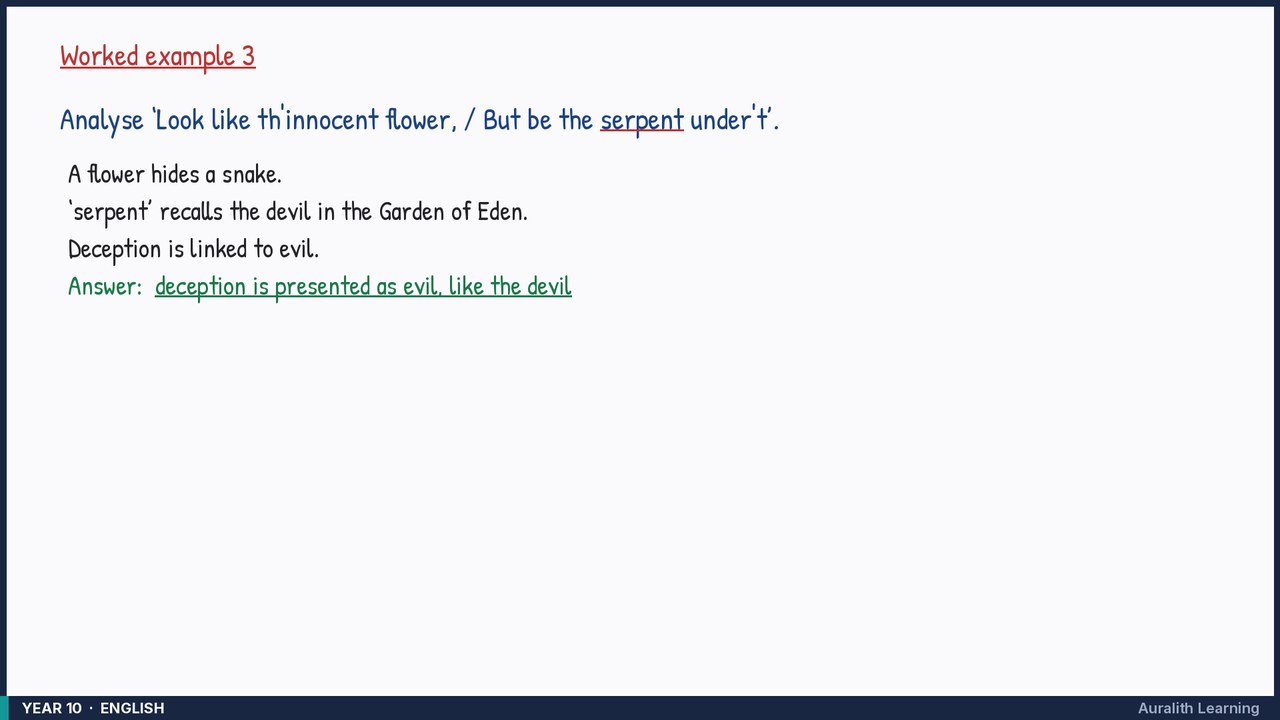
Analyse ‘Look like th'innocent flower, / But be the serpent under't’.
- Step 1: A flower hides a snake.
- Step 2: ‘serpent’ recalls the devil in the Garden of Eden.
- Step 3: Deception is linked to evil.
Answer: deception is presented as evil, like the devil